The 1879 Steam Canoe - Nina
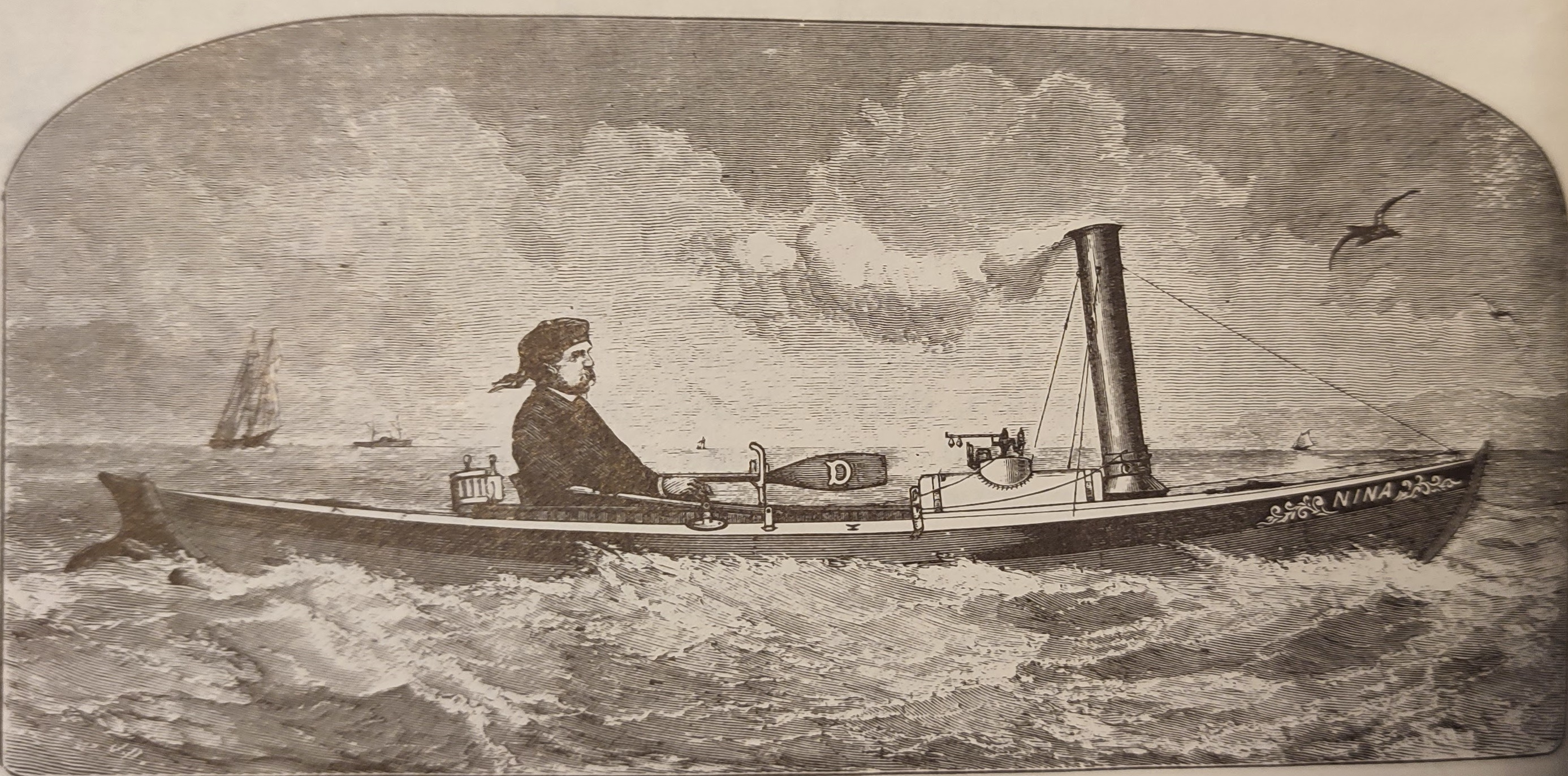
One of the earliest steam canoes is reported by Bill Durham in his classic series Steam Boats and Modern Steam Launches. Happily the whole of that series of magazines in available as a book. It is not clear whether it is still in print (as at 2024), but second hand copies are widely available.
Nina is listed a 14ft X 28" Rob Roy style wooden canoe with a copper fastened hull of hickory, oak and cedar. It is interesting that this design was being used for steam power just 14 years after it was first introduced in Europe by John MacGregor. The details of the boiler are rather sparce, and it does not sound like a monotube design, but was certainly a light water tube design. Thus the 'scotch' boiler shape shown in the lithograph was presumably cosmetic to fit in with the conception at the time of what a maritime boiler should look like.
It is worth noting from the picture that the hand feed pump is mounted on the right hand gunwale next to the skipper and draws water from whatever liquid the canoe is in. Given that the owner had it built to explore the River Hudson, it is likely that there would have been a high degree of salt and silt in the feed water. Given the light weight it is likely that the operating pressure was quite low, in the region of perhaps 30 psi, but that detail is not given. To maintain the trim of the boat notice that the the engine is mounted directly behind the seat which allows the skipper to be almost in the centre of the canoe.
A paddle is prominent in a clip that looks as if it would hold it from being easily lost overboard. The funnel has four stays and appears to have a hinge at the forward side to allow for a smaller and more stable package for portage. It may even have been removable. The boiler was a water-tube design design, despite its 'Scotch' profile, 22" X 17" with a 10" firebox. There were apparently 22 transverse tubes with the lowest set acting as the grate. There is a balance weight safety valve, a whistle and SBMSTL suggests a mercury-monometer pressure gauge. The whole boiler set up apparently weighed 80 lbs (36.3kg) while the dry weight of the boat and equipment is reported as 215 lbs (97.5 kg). This makes an interesting comparison with the Dutch steam canoe Sirius. The engine is reported to have been 2 3/4" X 1 3/4" (probably 3HP) and apparently propelled the boat at 4.5 mph using 1 1/2 buckets of coal per day. The propeller was 14" diameter and a spare of 9" was carried for exploring shallower waters.
Sadly there is no further mention of Nina in SBMSL so what happened to her owner and the canoe is unkown.
Next: 1908 Steam Canoe
Previous: Origins of the Mono-tube Boiler