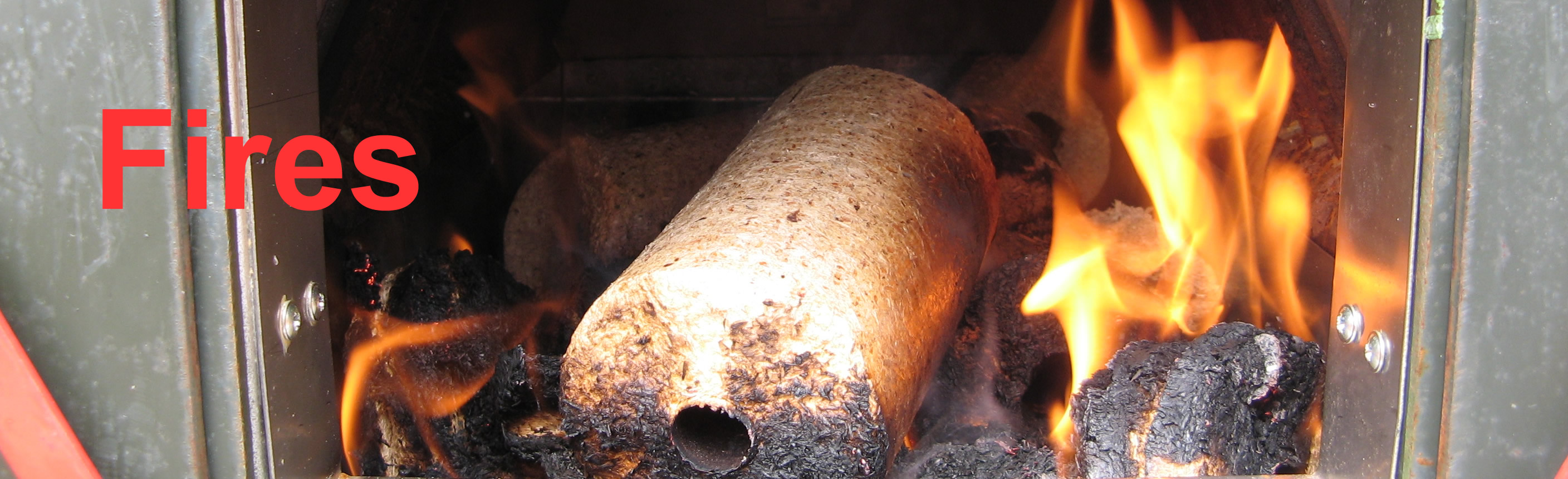
Fuel for the Mono-tube Boiler Fire
In the context of steamboating it is likely that the question of what to burn in the firebox is very much location based. In the UK where Welsh Steam coal is a revered product, the answer would normally be coal. In the US where the woods are extensive the answer would most often be wood. However, when the focus of the discussion moves to mono-tube boilers most often the expected answer would be oil of some sort or possibly gas. The logic for answers is that oil and gas are fuels for which it is easy to control the intensity of the fire and, in too many people's imagination, the monotube boiler is very difficult to control.
As is so often the case, this 'common sense' answer is too simplistic. Thus the news that Wally Mounster ran a steam launch with a mono-coil boiler fired with wood caused many a steam boater's jaw to drop. The reason that he ran it successfully for more than 25 years was that he knew the charateristics of of wood fires, had built an excellent boiler design and used partially automated boiler controls. Thus the 'take away' from this is that it pays to know what one can expect in terms of how the chosen fuels burns and can be controlled.
In the context of the 2020s, many people's attention is on the growing problem of Climate Breakdown. Thus burning fuel is considered by many to be an anti-social activity. However, it helps if steamboating is placed in the wider context of CO2 and other emissions from fuel use. A day's steaming with a canoe style launch would probably use less wood than might be used by a the wood stove in a medium sized house in one night. Emissions from driving any distance to a steamboat meet will far exceed the emissions from the boat itself, while the emissions from even a short haul holiday aircraft flight will exceed that by many times.
Assuming that the steam plant has been designed for solid fuel then thought does need to be given to replacements for coal. The main reason for that is that coal is becoming increasingly difficult to obtain since mines are closing and public opinion backs the idea of leaving coal in the ground. Happily, there is quite a large flow of flammable waste that could be used and is being tested by Heritage Railways and others. (see: Lynton & Barnstaple Railway Yellow Coal trial) (The Winding Road to Yellow Bricks)
On a different page John Emmett explores the issues of using Renewable Fuels for steamboating purposes. On the section below John explores the contentious issue of firebox shapes. The 'traditional' fire tube and water tube boilers have evolved a general, but not standardised, approach to the firebox. However, mono-tubes based on coiled pipe, offer the designer a challenge in how to surround the fire by coiled pipe and get one's coal shovel over the grate.
Trying different firebox shapes
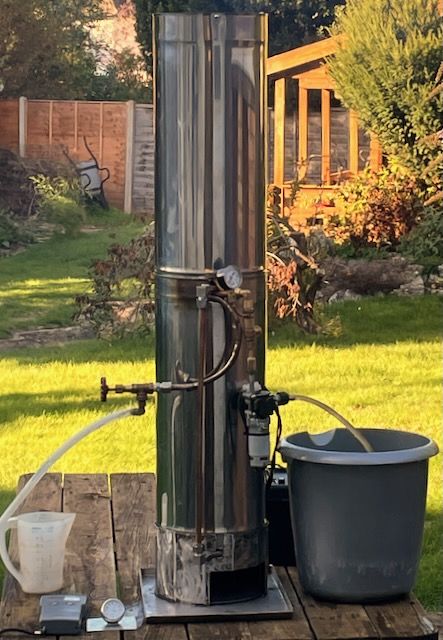
Having tried out the broad low "Barbecue" style firebox of Snipe, (See here) I though that it might be interesting to try a tall narrow firebox, in the style of a "Rocket" stove. Here is a 20cm diameter test boiler in three parts;
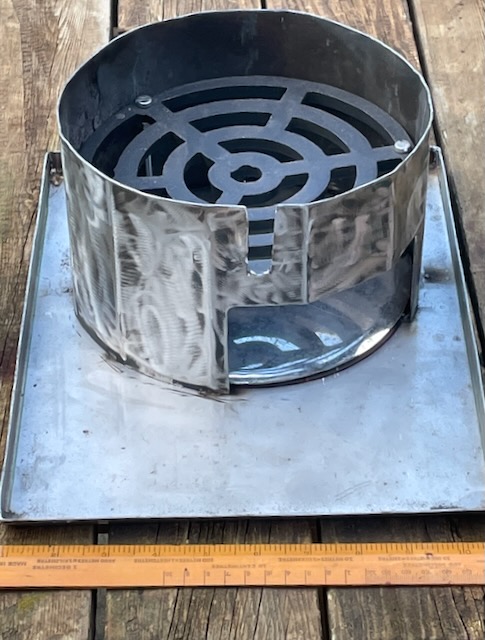
The grate is a 20cm diameter cast iron drain cover, mounted on three stainless screws above a 0.5mm thick stainless heat shield, on a 1.2mm stainless base.
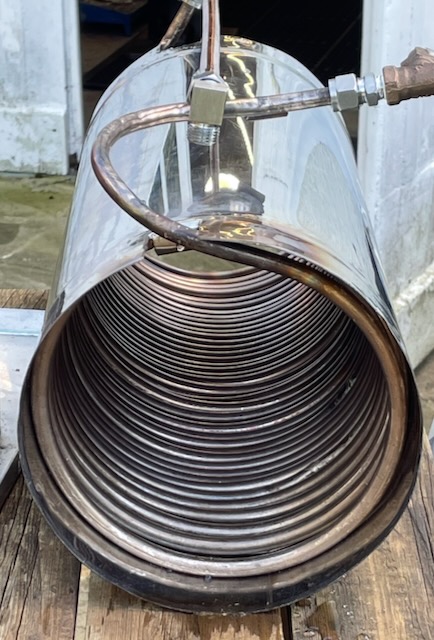
On top of this fits a 50cm length of 20cm diameter flue pipe, containing a spiral of 10mm x 1mm wall Cunifer tube, totalling some 20 metres. This fits on top of the grate and forms the fire box.
The t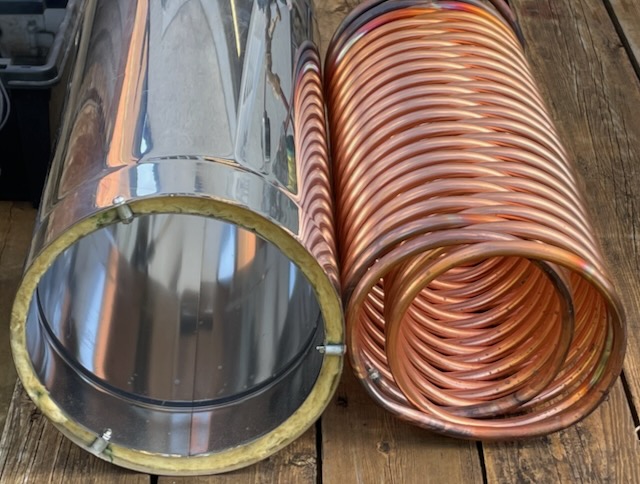 op section is another 20cm diameter flue section, with an insulated 18cm diameter length inside. Inside that is an interlo
 cking spiral of 10mm x 0.7mm copper micropore tube, again about 20metres in length.
And this is it assembled.
Here you can see the pump supplying around 3 litres of water per minute, and a thermometer measuring the water temperature rise.
And yes, you can get a good roaring fire out of wood briquettes simply dropped down the funnel. So far I am seeing temperature rises of 65 deg C at peak, equivalent to 9 grams of saturated steam at 100 psig per second. That corresponds to a whopping 32kg of steam per hour.
The complete set up weighs just over 20kg, although you would need to add a separator and fittings to that. The question is; could it be made to look sensible in a boat?
Next: Ancilliaries
Previous: Boilers Gallery