introduction
Anybody who sets out to recommend that people should use a particular hull with a mono-tube steam plant is probably asking for trouble. Perhaps a safer approach is to pick up on some of the characteristics of the mono-tube steam plant and consider whether they point to a particular family of hulls.
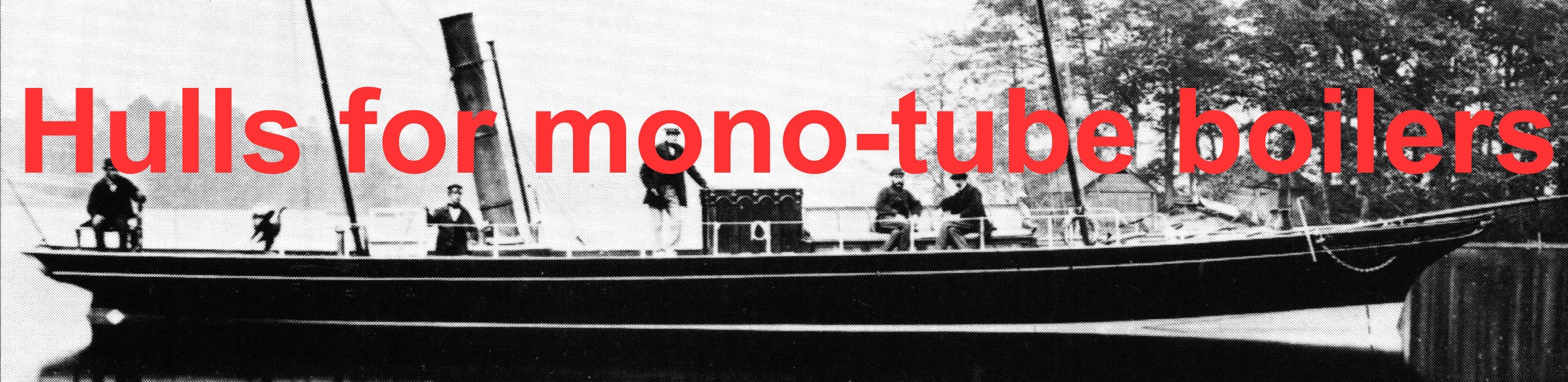
Briefly, it is safe to say that mono-tube steam plants tend to be light in weight and match well with a small engine running at fairly high speeds. In addition, given that steam plants of the smaller type deliver small amounts of power, the hull needs to be driven very easily. Such hulls, as the historical evidence suggests, tend to be pencil shaped rather than following the egg box shape of modern 'Gin Palaces'. The sort of boats that would match with that specification include canoes, skiffs, and replicas of classic recreational boat designs.
In the sections below we hope to illustrate how this conundrum has been solved by various boat builders. First, we begin with the Canoe concept and start with a design by John Emmett
Remaining with the canoe concept we offer the following unfolding story of how a pretty canoe design could be evolved into a 'pocket steam launch' and the show the thinking involved. This will expand over time...
Our next suggestion is the conversion of an existing boat which, in this case, was a rowing skiff built in 1910 and not quite in pristine condition when found. However, that did not stop Barry Watson as is explained in his build story:
Hull Types
Canoe - Snipe, Fairlight 406
Rowing Skiff - Alba
Modern 'Classic' design - The 'Rose' hull
Another modern classic - Frolic 18 and Frolic 21
Next: The Question of Propellers
Previous: Hulls for Mono-tube Boilers