Connecting the Shaft to the Engine
9th January 2023 - Connecting the shaft to the engine
For many powered small craft the 'normal' connection between the engine and the drive shaft would be a universal joint or a constant velocity joint. The former are less good than the latter because the flexing of the joint leads to the output side of the joint speeding up and slowing down by a small amount once per revolution. This introduces vibration into the shaft. This does not happen to the same extent with constant velocity joints which is why they are so widely used on high speed applications. For such an application as the Fairight three quesions probably should be asked. Firstly, is a flexible coupling really neessary or can the engine be 'canted' and a direct connection be adoped? Secondly, what are the costs of suitably sized joints and is the expense warranted in this application? Thirdly, are there any low cost DIY solutions?
Taking the first issue, the current state of the design suggests that the drive shaft will slope at about 6 degrees. However, no work has yet been done on the loading of the boat when the operator, fuel and water are added. Thus it is possible that the engine may need to move somewhat further forward to ensure that the boat trims to the design water line. Such a move would lower the angle further. With such a low angle it would seem logical that a very slight 'cant' to the engine beds would allow the use of a direct connection.
Suitable flexible connections are widely available but the easiest to find are the Univeral Joint type. Typical would be the 65162 Double Universal Joint by Wixroyd (Wixroyd) which includes a 12mm shaft version with key way (W0212). That retals at £50.86 with a suggested shipping charge of £13.50. The non keyed version is £42.01. For once eBay does not seem to offer aything useful except CV joints for specific motor vehicles or UJs for radio controlled model vehicles. This may possibly be the reason why many SBA launch build stories mention that the builder has salvaged a CV joint from a car breaker's yard. The new UJs all look to be nicly made parts but £60 for a 'simple' connection seems like quite a lot of money.
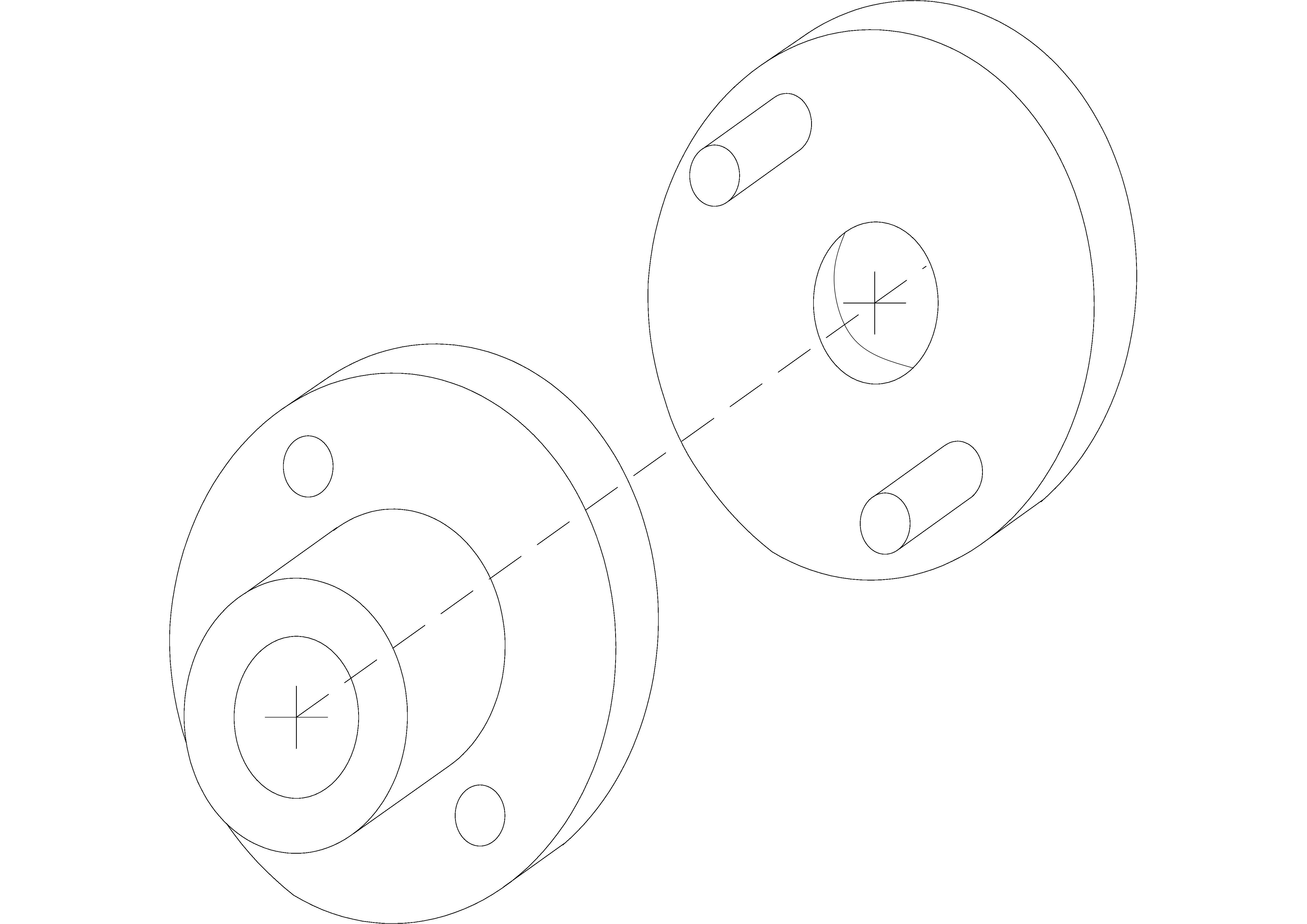
Finally there is the possibility of the DIY connection. One solution that can cope with small mis-alignments is the pin connector which is basically a flange coupling, probably on the engine flywheel, that has two pins projecting from it. This is mated to a similar flange coupling on the drive shaft that has two holes into which the pins fit. The fit is 'easy' so as to allow for slight misalignment that a 'tight' fit would not permit. (See diagram below).
 Cast iron flanges suitable for this task do not seem to be readily available, but a product known as a QD Bushing (Quick detachable) might offer a ready made solution. When searching for QD busing the majority of items that emerge are for Taperlock style bushes. However, there is also a very similar product known as a 'Split Taper Bushing'. Finding UK supplier has been difficult, but the latter product is available from Raptor Supplies who have sites in England, the Netherlands and Australia as well as doing mail order. (Scroll down a long way as the first half of their page lists Taperlock style bushes. In the USA McMaster-Carr have QD Busings starting at 1/2" shaft size. (See drawing below for 1/2" shaft size) Also in the USA there is Grainger who supply something similar.
The issue of connections and alignment of shafts has been covered in Funnel at various times over the years. However, the comments by John Maltby in Issue 48, Summer 1986 (with a winter snow scene on the cover!) are worth repeating as is his suggested DIY coupling which is somewhat more sophisticated than the one shown on the left.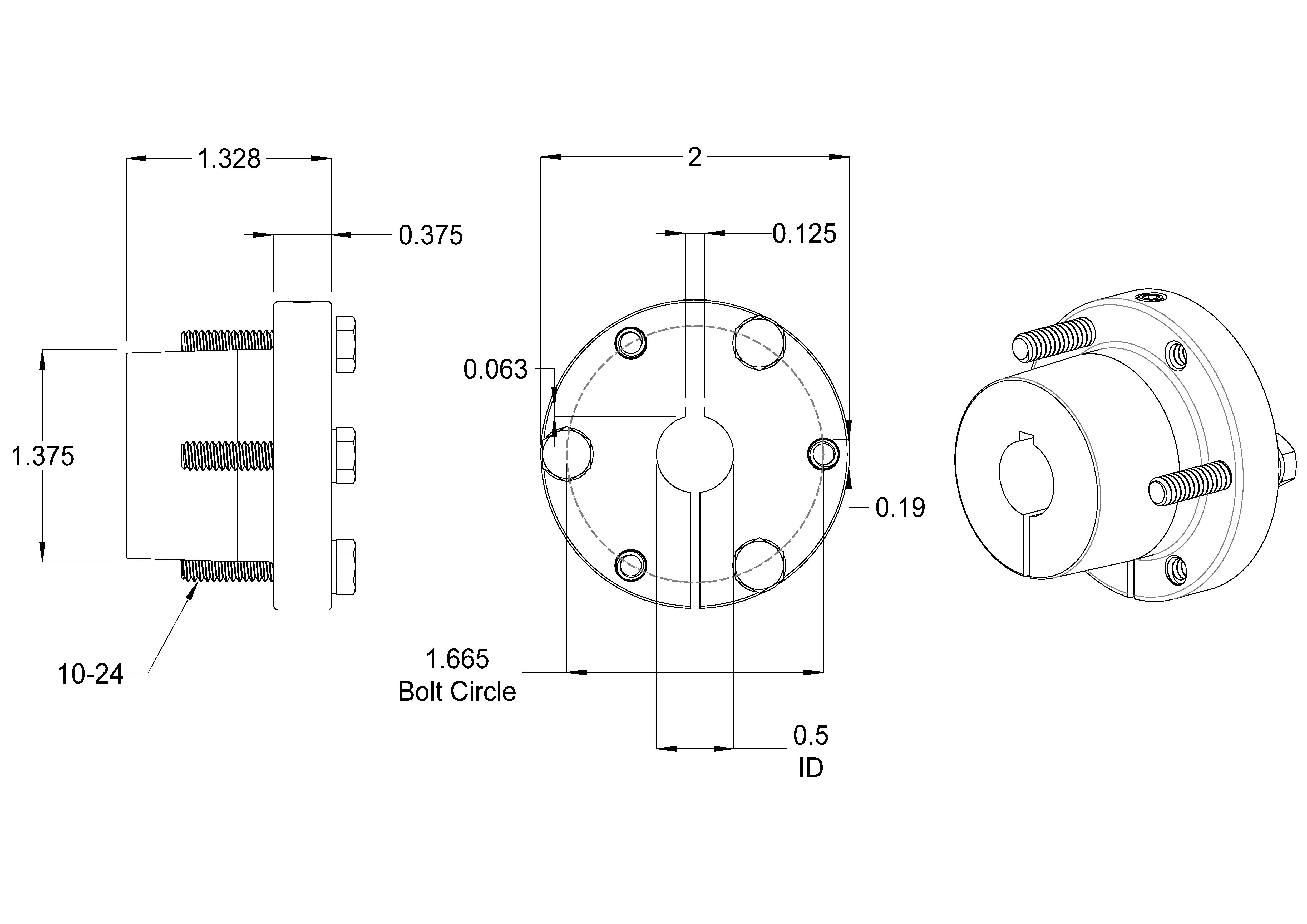
"There are many types of flexible coupling available. The types generally offered from boat equipment suppliers are usually required to transmit the thrust to the gearbox of infernal combustion engines, so we would be better looking at industrial couplings. Universal joints as used on car prop shafts are not to be recommended unless a complete shaft eg. two joints plus a sliding coupling are used – and this is rather unsightly.
For smaller plant the gear type of coupling is ideal; the 'Bovex' coupling is basically two toothed pinions connected by a plastic sleeve which has internal teeth to match. Axial float ensures that no thrust is transmitted. These gears are, however, not too tolerant of misalignment.
Many makes of 'spigot & rubber pad' couplings are available (E.g. Marshward Power Transmissions Ltd) and Fenners Ltd. supply a range of couplings using a conical rubber insert; these are ideal and can be operated with some misalignment.
Coupling flanges etc. are best retained using Fenner’s Taperloc system of tapered bushes, secured with Allen grub screws. These can be removed without recourse to a big hammer or pulling device, as this is difficult when you're head-first in a small bilge. (See Texam Design Engineering for example)
Remember - a short rigid shaft arrangement is less tolerant of misalignment than a thin long shaft. For those like me - of limited means, a home-made spigot coupling has worked well on SALOME. ( See FIG 3)"
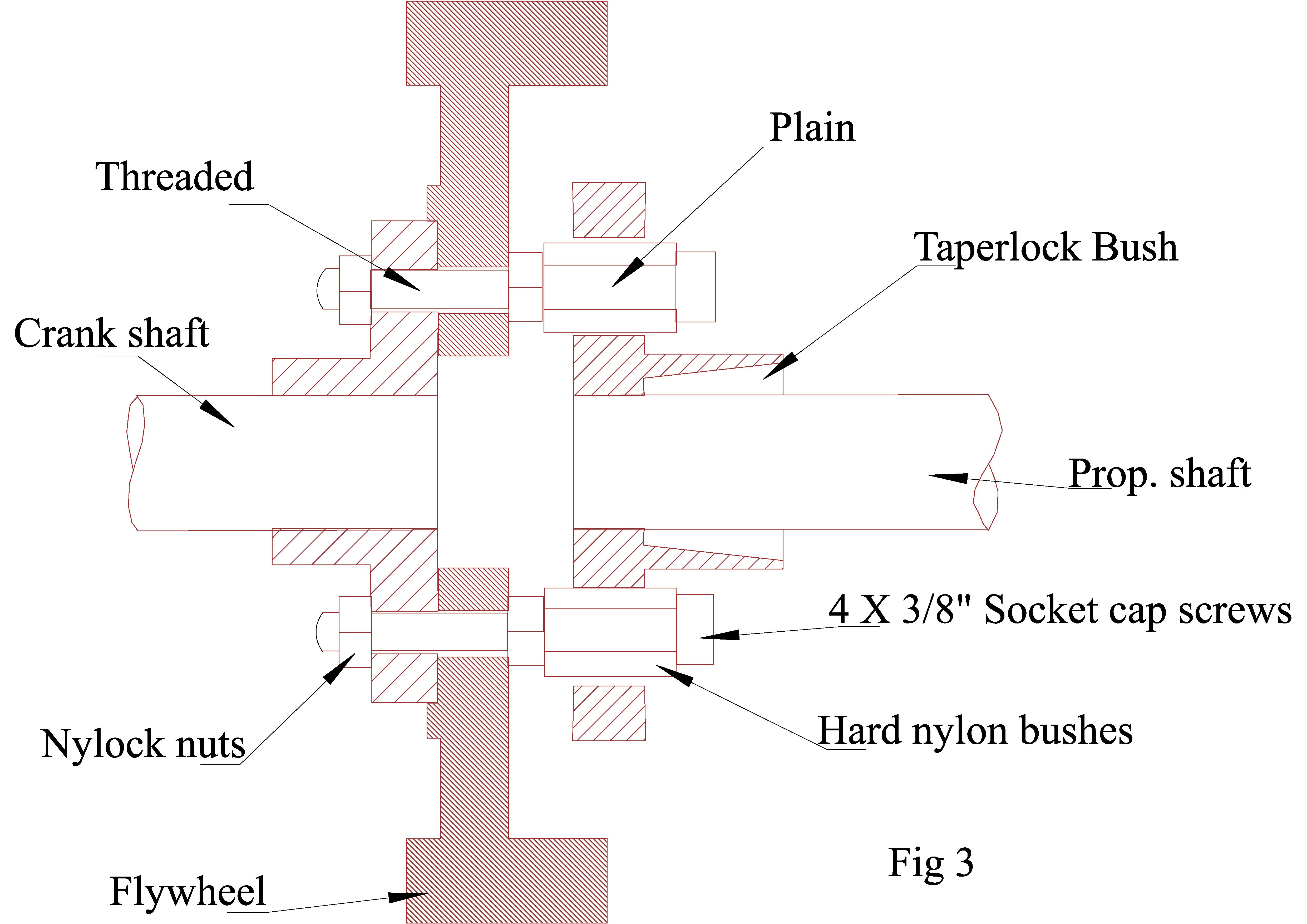
This system is rather less forgiving than the very simple system shown earlier, but with the nylon bush does allow some movement. The only troble for both the very simple system and John Maltby's system is getting hold of ready made cast iron flanges. John suggests getting a pulley wheel and then turning it down to the desired size. Plain cast iron flanges no longer seem to be available anywhere online but the QD and Split Taper Bushes mentioned above might make very good substitutes. (If you know differently, please let me know).