Propeller Shaft and Stern Tube
14th November 2022 - Propeller Shaft Sizing
According to Gerr, the oldest and most useful ‘rule of thumb’ for specifying a propeller shaft’s diameter is the ‘One-forteenth diameter’ rule. Thus the shaft should be 1/14 of the diameter of the propeller.
Assuming that the chosen propeller diameter is 10” (254mm) then using this rule the shaft should be 23/32” (18.14 mm) in diameter. For the 13” propeller the shaft would be 60/64” (23.5mm. However Gerr also offers a formula that takes in a wide range of variables related to the task the shaft must perform:
D1 = Cube root {(321,000 X SHP X SF)/(St X RPM)}
D1 = suggested diameter
SHP = Shaft horsepower
SF = Safety Factor (3 for yachts & light Commercial Craft, 5-8 for heavy commercial & racing craft)
St = Yield strength in torsional shear (Stainless steel is about 50,000 psi)
RPM = Revolutions per minute
Safety Factor 3 Assumed
Thus D1 = Cube root {(321,000 X 2.557 X 2)/(50,000 X 600)}
Top line = 2,462,391
Bottom line = 30,000,000
Fraction = 0.0820797
Cube root = 0.43458885713 inches(11.038556971102 mm)
From this formula it looks as if a 12mm stainless steel shaft would be satisfactory.
19th November 2022 - The Stern Tube and Propeller Shaft – The DIY version
Stern Tube
¾” OD 16 swg Ali Tube (19.05 mm OD X 1.626 mm)
15.7 mm ID
Lengths – 2500mm £8.25
5000mm £16.50
Source: Aliminium Warehouse
Sleeve Bearings – Plastic
According to Essentra Components Polyamide Slide Bearing with flange are suitable for DIN H6-H7 Fittings, the bearing clearance is approximately 1% of the shaft diameter after assembly.
Flanged Bearing 16.0 mm (ID) 20.0 mm (OD) 15.5 mm PA Item code: 008160300002
OR
Flanged Bearing Sleeve Bearing - Inside Diameter 12.0 mm | 0.472 in; Outside Diameter 14.0 mm | 0.551 in; Black. PA, CF, PTFE
Item code: 008729011442 Sold in packs of 5 units for £14.35 plus £8.50 delivery.
Given the dimensions of the bearings there is something of a dilemma:
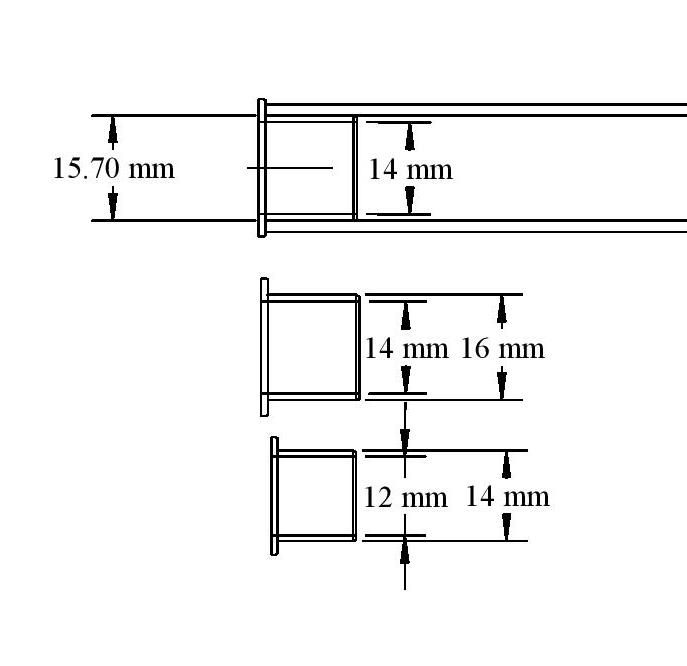 The ¾” ali tube has an internal diameter of 15.7mm. That would be a tight fit for a 16mm OD sleeve bearing making it very secure. However the hole for the shaft is 14mm whereas the Gerr based calculation for shaft size recommends a 12mm shaft.
Given that the shaft will be about 1500mm long the difference in weight will be worth calculating
Grade 303 austenitic stainless steel has a density of 8.03 Kg/m3.
The volume of a shaft of 12mm diameter by 1500mm long is 169.641cm3 = 1.694 m3. Thus its weight will be 13.6kg.
For a shaft of 14mm diameter by 1500 long the volume is 230.9cm3 = 2.309 m3. Thus its weight will be 18.5kg, giving a weight penalty of 4.9kg. Given the need to save unnecessary weight, it would seem sensible to go with the 12mm diameter shaft.
One solution to the problem of a 16mm ID stern tube and a 12mm propeller shaft is a ‘fatter’ sleeve bearing. Internet searching has not turned up much but one find was Igus who make bearing of 'Iglidur'. The latter is a composite material made up of a polymer, a filler and a lubricant material. The presence of the latter means that the bearing are designed to be lubrication free. The site throws up one items that meets the specification and that is iglidur® M250, sleeve bearing with flange, available with a 12mm diameter centre hole and an outer diameter of 16mm. The downsides of this product are that the bearing absorbs water and is not recommended for wet area use. The price is also quite high being £5.90 per unit with £8.50 shipping cost (presumably per order). The firm has been contacted for more information about the water absorption issue and the answer will be added here when it is received. [January 2023 Update - the firm has not bothered to respond to the query]
There are several other solutions to the Sleeve Bearing issue. Firstly, the 12mm ID bearing could be used and wrapped around with a ‘shim’ of 0.785 mm material. This could be made up from drinks can metal which is, according to the Internet, about 0.086 mm thick, so looped around several times. Alternatively, there is Gorilla Tape which, according to their Technical Data Sheet, is 0.4318 mm thick. That should do the trick with a single loop, though getting the tape to stay in place when pushing in the bearing could be an issue.
Secondly, if there is access to a lathe, it would be possible to turn a bearing from round plastic bar.
The three contenders for this sort of task are PTFE, Acetal and UHMWPE.
PTFE - In low friction applications, it performs significantly better than Nylon and Acetal; it is comparable to ultra-high-molecular-weight polyethylene (UHMWPE), although UHMWPE is more resistant to wear than PTFE. Because of its softness, inherent low friction and resulting “slipperiness”, PTFE can be difficult to chuck and hold tight in a lathe as it can crush and/or distort. It is also recommended to use a high speed lathe and sharp tools, and slow feed. Another consideration for machining is the long strings of swarf, which can wrap around tooling.
Acetal - Acetal Rod is described as being very slippery. What this means is that components will have very low friction characteristics as well as minimal initial stick. This is good for when small rotating components that need to be started very smoothly during their service, Acetal will not require any great load applied to initially create movement which often creates jerking which is a real issue in micro components. Acetal Rod is probably the best machining engineering plastic. It makes the machining process very easy by chipping rather than creating a continuous length of swarf that often wraps around tooling. By using very sharp cutting tools that are designed similar to smoothing tools, Acetal Rod can be machined to an outstanding surface finish with machining marks barely visible.
UHMWPE - It has a very low friction co-efficient and provides a bearing medium that is very free running and exceptionally long lasting. A very tough material, with the highest impact strength of any thermoplastic presently made. High speed steel tooling is recommended with lots of back rake, side rake and clearances, and a generous nose radius. Use caution when turning UHMWPE as the chips will be continuous and tend to wrap around the tooling so a “pecking action” is advised. It has extremely low moisture absorption, a very low coefficient of friction, is self-lubricating and is highly resistant to abrasion. Very resistant to water, moisture, most chemicals. Resistant to micro-organisms. UHMWPE will deform continually as long as the stress is present, an effect known as creep. Maybe not suitable for high load applications.
(Product characteristics taken from the Direct Plastics website.)
PTFE and Acetal and UHMWPE round bar stock is widely available. EBay has plenty of vendors offering white PTFE of 20mm diameter by 100mm length for around £9.60 with free postage. Acetal is available after some searching on eBay at £3.95 for 20mm X 100mm. Ebay also offers UHMWPE bars in 20 mm diameter and 500mm length for £8.52 with free postage. All three are available from Direct Plastics but generally in longer lengths which is more than this project requires.
On the basis of price UHMWPE appears to be the winner but is not the best for machining if a flanged bearing is to be created. Of course an unflanged bearing could be used and secured in the stern tube with a couple of grub screws. Acetal comes second in the price stakes and must be the winner if it is intended to make a flanged bearing as it machines well. PTFE probably drops out of the race on the grounds that it is significantly more expensive, difficult to machine and has a tendency, like UHMWPE, to creep.
One possible other contender is Acetal C Extruded Natural Hollow Rod which is available with 20mm OD and 12mm ID. The suppliers are quite hard to find but it is clearly listed as being available on the site of Plastock but at the time of writing was out of stock. The serious downside of Plastock is that they have a £25 minimum order. Ebay seems not to list this product.
Thus the final conclusion for home made bearings, assuming that the interesting Iglidur® M250 sleeve bearing turns out to be unsuitable, is to go for 16mm Acetal round bar and drill and ream it. Changing the stern tube from ¾” OD by 16swg to something smaller with a 14mm ID would seem the most sensible alternative solution. The Aluminium Warehouse offers ¾” OD 14swg tube that has an internal diameter of 14.7mm. However, the unanswered question is the 0.7mm ‘slack’ between the tube and the size of the widely available sleeve bearings. Is that too much? This is where expertise from elsewhere is required.
Next: Connecting the shaft to the Engine
Back: The Propeller