Building a 21st Century Steam Canoe
Introduction
“Stitch and glue” boatbuilding was developed by woodwork teacher Ken Littledyke around 1960. These were later sold in kit form from his shop at Ramsey in Cambridgeshire. They used 3mm marine plywood panels joined by fiberglass tape and resin. This technique was popularised by the Mirror Dinghy in 1962, the Mirror being so named because the design was sponsored by The Daily Mirror newspaper, a relationship reflected by the traditional red sails.
In 1980, a complete 16 ft Kayel Canadian Canoe kit cost £125, equivalent to approximately £500 in 2020 prices, and the 1980’s steam canoe Sirius 6 was built from just such a kit. (Fig 1, Fig 1a).
Since then, glued bead and cove wood strip construction has emerged as a modern version of traditional Canadian cedar strip canoe construction. Unfortunately, you would need at least £800 wo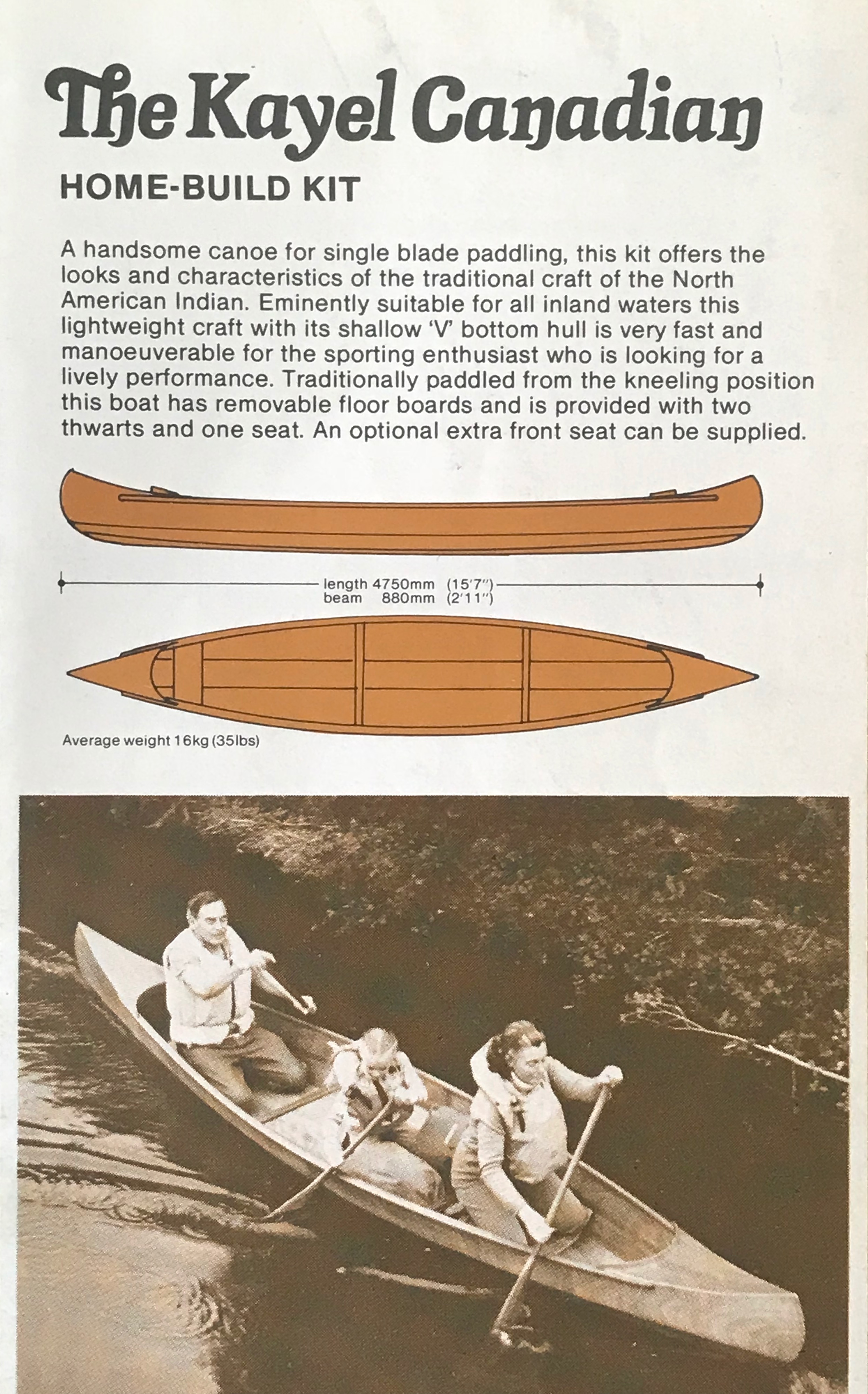 rth of stripwood alone for a similar boat, more than doubling the build cost using sewn plywood.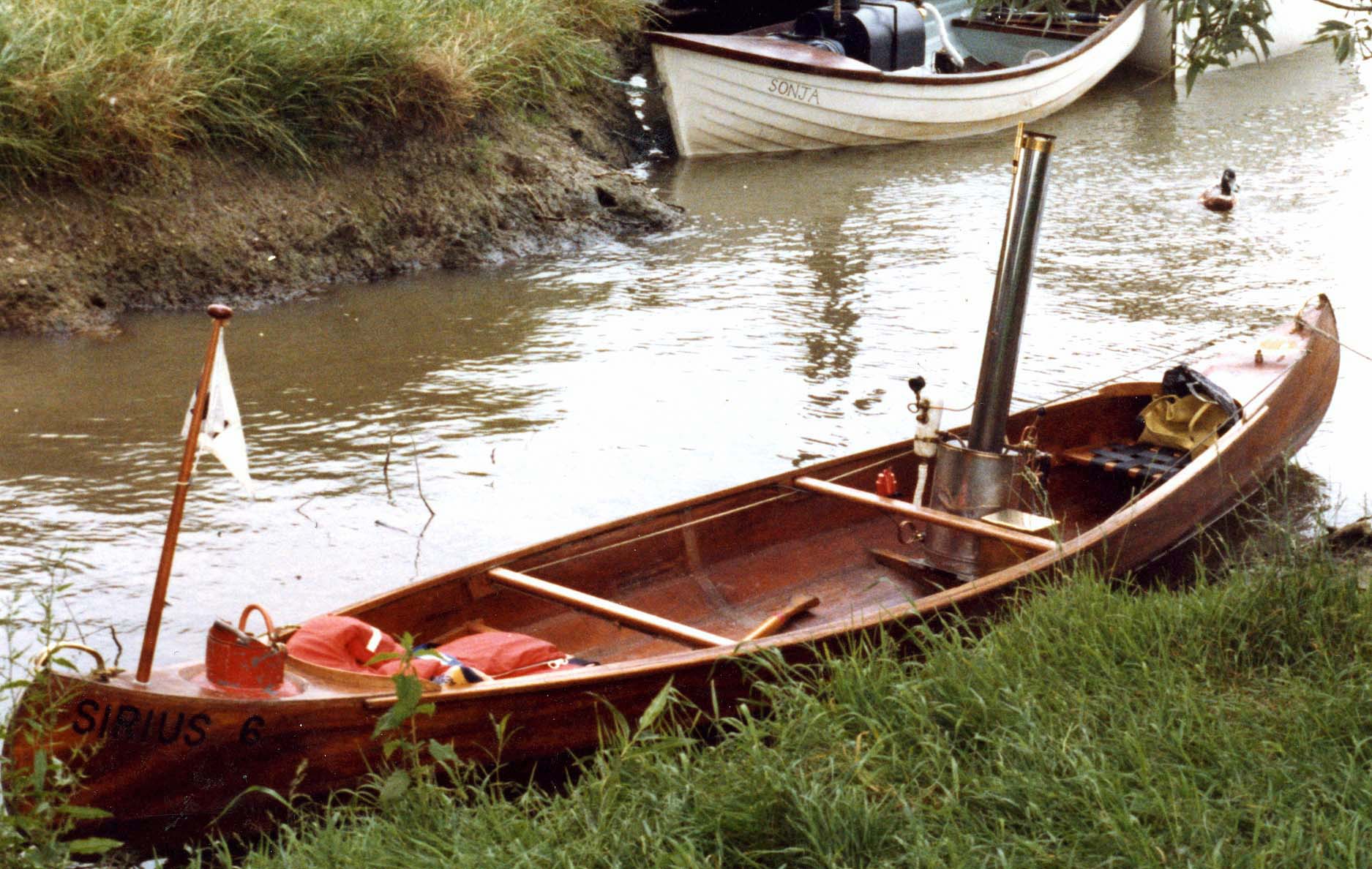
Although not a traditional canoe technique, glued ply clinker construction over mdf formers would also be a very economical and efficient way to build a skiff type of hull.
Each of these techniques has design limitations; ply can only be bent into conical sections, and should not be used in large flat areas. Cedar strips and clinker on the other hand, are limited to smooth curves.
Materials for 2020
Plywood
Marine Plywood has changed little in principle in maybe 80 years, but the hardwoods used in its construction do vary according to the current availability and production country. One good thing is that transport costs have reduced greatly since the 1980’s, although you may well find that tropical hardwood ply stockists are still based near the South and West ports of the UK, whereas if you want Birch ply for Loudspeakers, that usually arrives from the Baltic into the North-East Ports.
Whatever you use, BS1088 is the standard to look for, and in 2022, you should be able to find either 3,4 or 6mm thick 8ft x 4ft sheets for less than £80 each.
Stripwood
Suitable Hardwoods and Softwoods for boats need to be affordable, durable and relatively straight grained. On the basis of reusing woods from commodity applications with competitive pricing, stair treads come to mind, as two 100kg people standing on one stair produces quite a stress. Currently, a local wood yard has planed planks made from 32 x 300 mm sawn straight grained Southern Yellow Pine for £25 per metre and up to 4.8 metres in length. These can be easily cut into suitable strips using a £100 electric table saw.
Don’t dismiss hardwoods though, as for a similar cost; Iroko, Meranti and Sapele should be available. Pale light Paulownia is a hardwood too, (as indeed is unsuitable Balsa). Other good softwoods include Western Red Cedar, Douglas Fir, and Larch, all of which, incidentally, grow in the UK although they tend to be knottier that imported woods. Overall, the choice is largely a matter of appearance and price, so below I have listed some reasonably durable but economical woods from lightest to darkest in hue;
-
Paulonia
-
Alaskan Yellow Cedar
-
Southern Yellow pine
-
Idigbo
-
Western Red Cedar (variable in colour, fades)
-
Douglas Fir
-
Iroko
-
Meranti
-
Larch
-
Oak
-
Sapele
-
Utile
This list isn’t exclusive, and unusual tropical hardwoods are sometimes available at reasonable cost. I haven’t listed any URL’s, because when you read this they will have changed, but if you search using terms such as “boat building hardwoods”, “marine ply” etc., you can soon build up a current list.
Adhesives
Glues have changed since 1980, and much for the better. As Dick Plum described in Funnel 187, D4 classification is an essential start, but under that banner you will find a wide range of subtly different single component Polyurethanes and perhaps unexpectedly, PVAs. One misleading sales expression is “solvent free”. Polyurethanes and Epoxies are genuinely solvent free and should not be thinned, but PVA is a water based emulsion and so easier to use and clean up.
The best advice I can give is to glue up some typical joints using the woods that you intend to use, then break them.
Paints and Sheathing
Oddly, despite revolutionary changes to car paints in the last 40 years, boat paints remain traditionally based. That is a good thing for me as I used the same International cream colour as I had last used on Sandpiper nearly forty years ago. On the other hand, my experiments with two component varnishes on ply were not a success, although water based exterior varnishes (which have a satin finish) proved excellent for floorboards etc.
Glass cloth sheathing if used, normally employs epoxy resins. The only problem being the chalking of the epoxy under UV light. An overcoat of suitable varnish is therefore needed if you follow this route.
Tools
Electric tools have got cheaper and gone cordless since 1980. I found an electric plane an overkill for this type of construction, but a small hand-held belt sander proved invaluable.
The Design Process
Revisiting Ideas
The original aims of such a hull were described in Funnels 177 and 179;
-
Easy separation of Hull and Steam Plant for single person storage and transport.
-
Utilisation of “Model” steam plants, which require smaller lathes etc.
-
Lightweight monotube boilers.
Two desirable improvements came to mind from those first-generation hulls which were described in Funnel 177;
-
A desire for crew to be able to stand up and embark from a high bank.
-
Better running attitude at high hull speeds.
Both these aims can be achieved by building a flatter wider stern, although purists might question if this is still a canoe if it no longer appears symmetrical.
Design Influences
Looking for influential hull shapes, I came across “Orinoco”, a 1950’s style rowing coaching and umpire launch. Once numerous on the Thames, this pattern of boats is being replaced by catamarans, which I admit would be far more practical if you needed to rescue a complete crew. 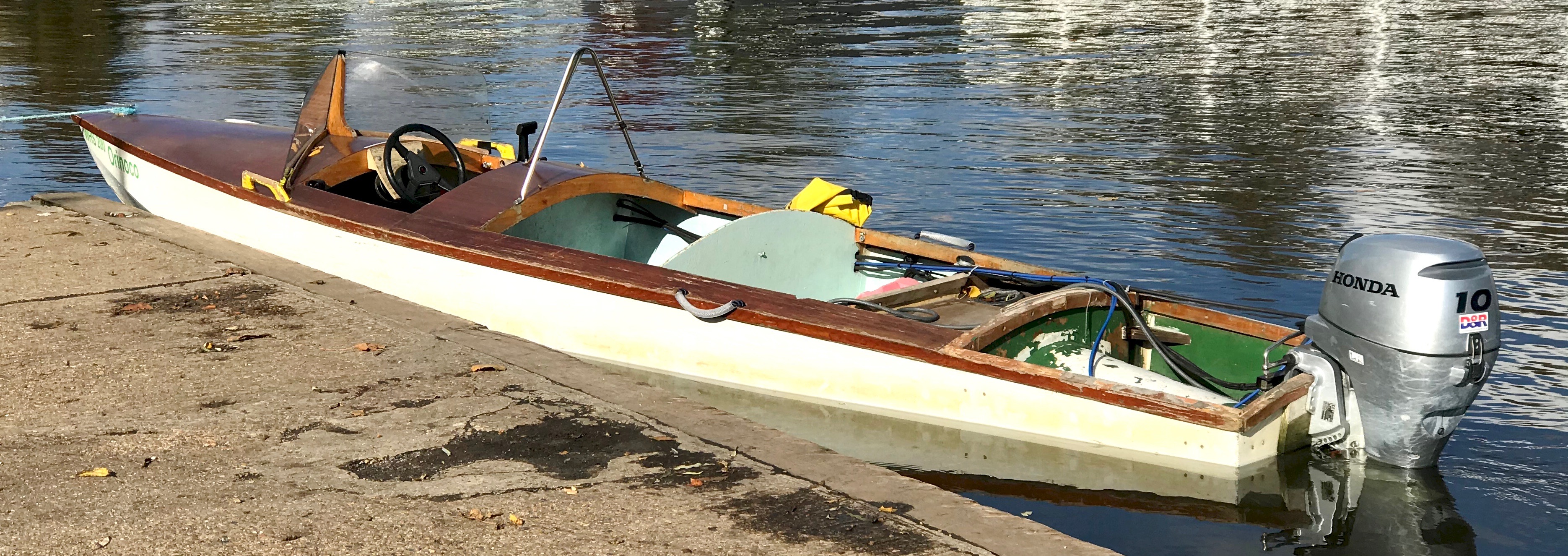
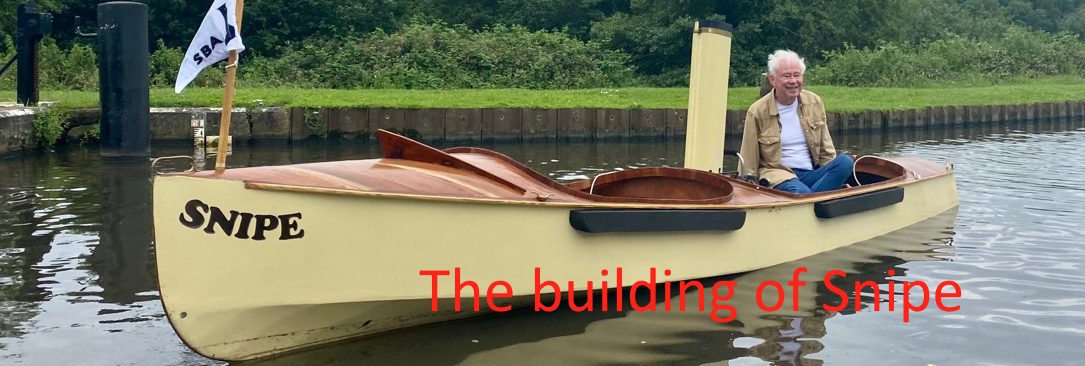
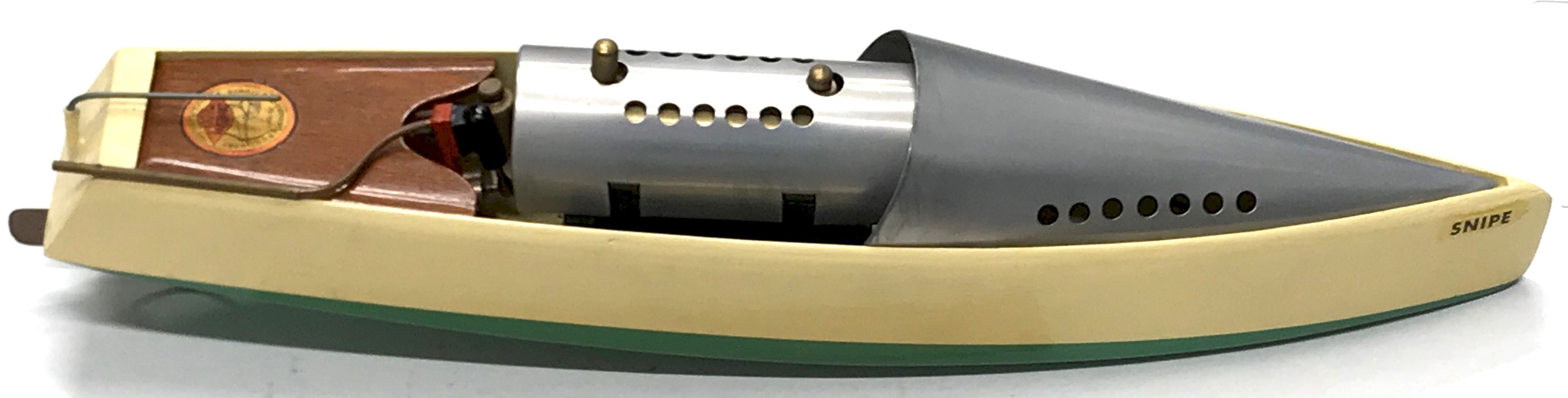
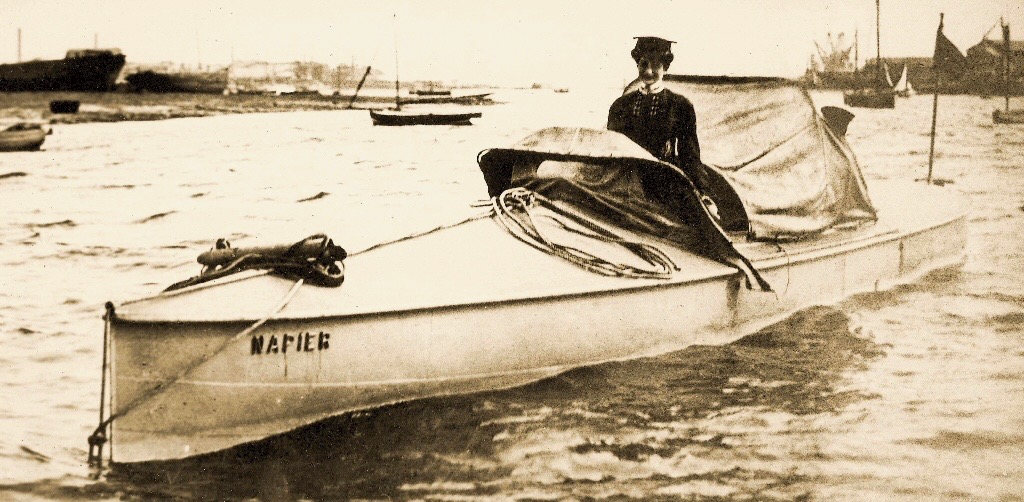
I can’t deny also that there is a bit of a Bowman “Snipe” in my design, and maybe a hopeful whiff of Dorothy Levitt.
 und it easy to make 1/5 to 1/8 scale models out of 2mm Depron sheet, from which all sorts of practical bath time tests can be performed, ranging from colour schemes to crew loading. The bending rules associated with ply construction which demand that all panels are sections of a cone tend to produce a rather blunt bow entry, so I diagonal planked the front 600mm of the bow section. You can probably spot a bit of sheer incorporated into the final hull as a result of studying the model appearance. The sheer should help manoeuvring, because straight bottomed canoe hulls are notoriously hard to turn.
3D CAD would be an alternative modelling format, from which you should be able to extract ply cutting shapes.
 Size
Size
There is no real advantage in reducing the overall length of your boat below a “cartopable” 5 metres, and longer length hulls can be joined on launching in the manner of a rowing eight. Weight of each component should be 40kg or less as this enables single handed operation, although I must admit that using a lightweight rowing boat trailer does enable it all to be transported ready to go.
With an overall length of 5 metres, a Beam of one metre should be adequate with 300mm of freeboard. The key point in scaling things is that a 20% increase in linear size corresponds to a 44% increase in areas (including the paint and varnish requirements), and a massive 73% increase in volume quantities, which includes weight.
Construction
Hull
I built “Snipe” very much as a big model, with stem and keelson temporarily attached to three 4mm formers on adjustable “workmate” stands ( Left). 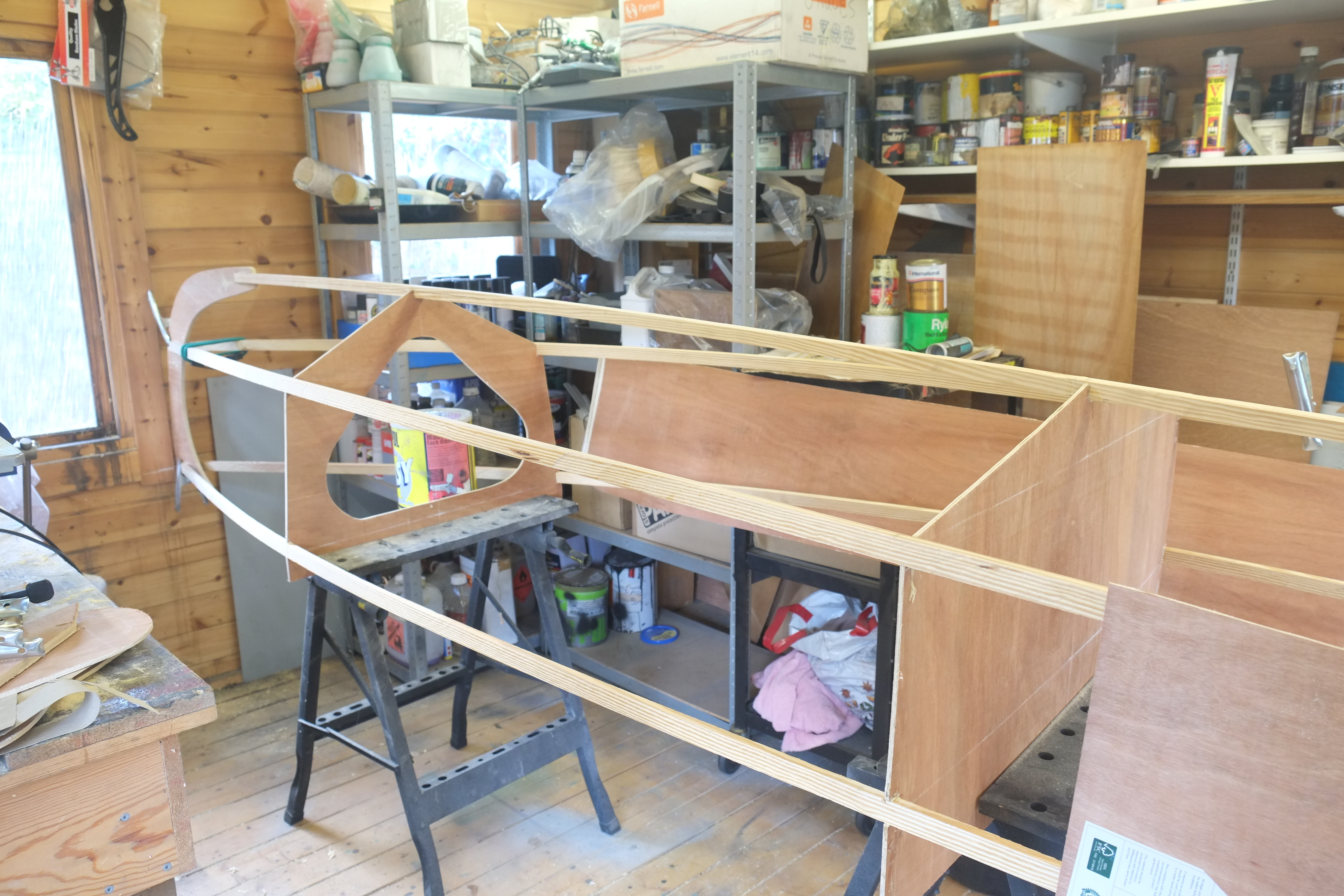 Chine strakes and gunwales were added and the whole sheeted in scarfed 6mm ply bottom, with 4mm sides. 600mm of the bow bottom was double diagonal planked in 3mm ply, using temporary staples whilst gluing. The hull was then turned right way up with the last false transom former and outer gunwales added, then the curved 4mm transom itself and finally the decking in 8mm flexible ply.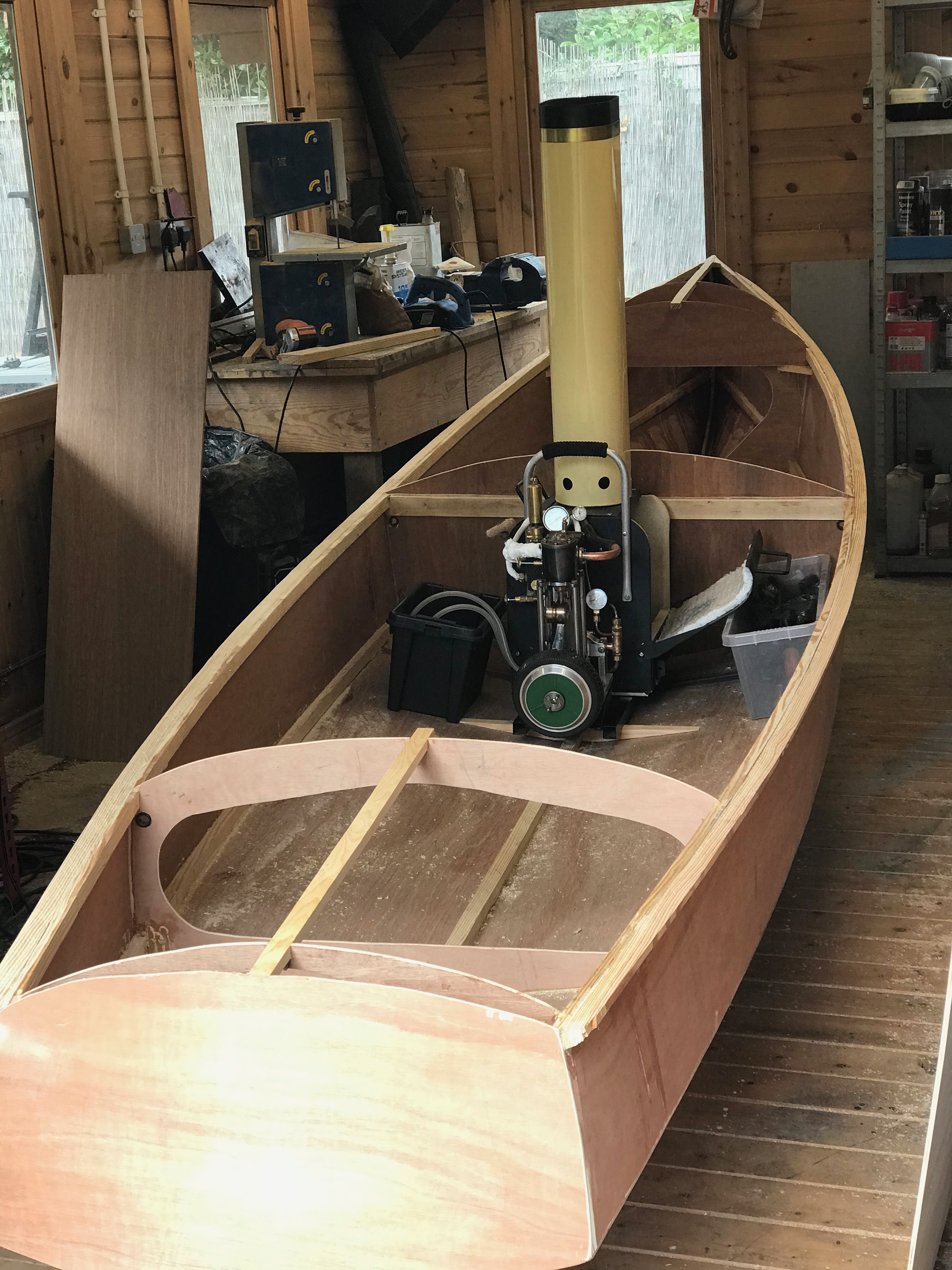
Decking and Coaming
8mm flexible ply makes remarkably light and rigid decking, although it is not made from the most durable of woods. It was veneered with 2mm mahogany veneer strips and two layers of the same mahogany are used for the cockpit coamings. 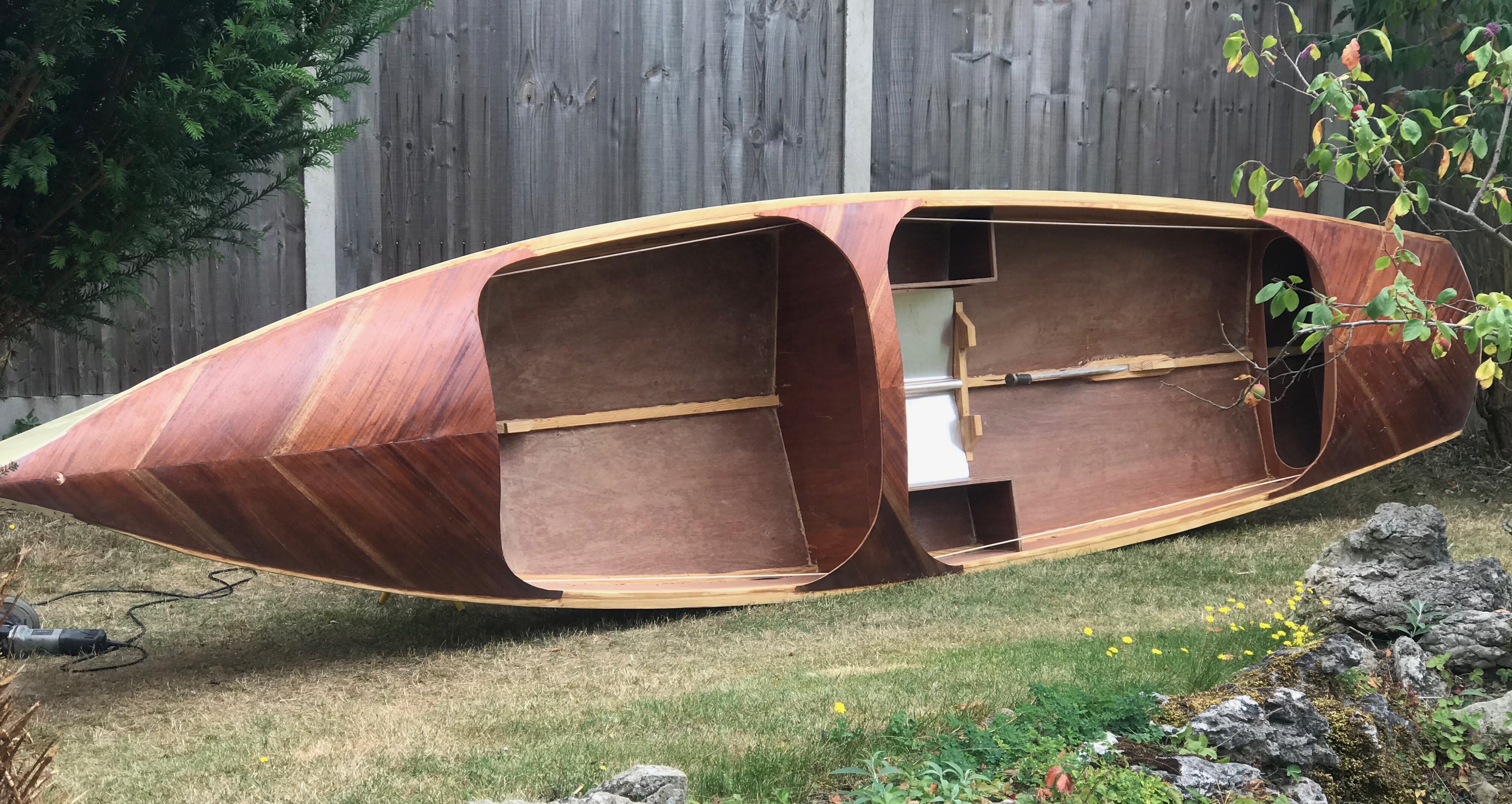 The bow decking is quite high, as it was originally intended to disguise a 10kg composite gas bottle in a container. It therefore provides a good dry storage or floatation bag space, with the proviso that unless you can get your shoulders through the bulkhead cut out, your reach is limited to 750mm inside that space.
Seating
The traditional Canadian canoe has no seats, as they were paddled kneeling or sitting on the freight loads. The heavy Thames electric canoes had high floorboards over the batteries, so Punt style cushions and seat backs were used. Full width floorboards however, weigh a lot and contribute nothing to the hull strength. In addition, although comfortable for the passengers, the engineer needs to be seated upright, almost over the plant rather than shuffling around on their bottom, so webbing seats or maybe pool “bean bags” would seem to be the best seating options. In the latter case, they can be strapped to the chine rails and provide plenty of buoyancy.
Whatever you choose for seating, it is important that everything needed is to hand as you can’t easily climb over the plant.
Fitting Out
The shaft here is made from ½ inch diameter stainless in an aluminium tube with nylon bearing sleeves. There is an aluminium P bracket at the stern, screwed into 6mm ply doublers inside the hull with stainless screws. Other items of deck furniture are from bronze or brass half round, including the useful and maybe unique bow and stern lifting handles. The 12 x 12 two blade prop is fabricated from 4mm brass sheet blades, silver soldered to a brass taper hub. There is a two pin coupling for the engine flywheel, and marks on the engine flywheel show when the prop is horizontal for beaching.
Steering
A particularly useful steering system was copied from Sirius 6 and it uses lines that run from a yoke on the rudder forward through plastic grommets along either gunwale, and back to the yoke with a spring joint across the front bulkhead. It uses standard synthetic small braided line. The rudder shaft is from 3/8 stainless steel in an aluminium tube with plastic sleeves.
Additional Equipment
The usual kit for a solid fuel steam launch, apart from gloves, tool kit and fire lighter kit, would include paddle and bailer and battery navigation lights. It is wise to carry an accessible small anchor on rivers with weirs, and lock keys will be needed for canals. Not just the square key handle for opening the paddles, but also a “CRT Watermate” Yale key for some swing bridges and canal toilets etc., and an anti-Vandal “Handcuff” key for Urban locks. Fenders always seem to me to be an unnecessary fiddle on small craft, so I have added two one metre side strips in 100mm x 50mm closed cell foam each side, glued on with upholstery adhesive. These provide a useful 200N of buoyancy too. After a couple of years, I have changed these for foam pipe lagging on the gunwales, which I think looks better, along with a white funnel.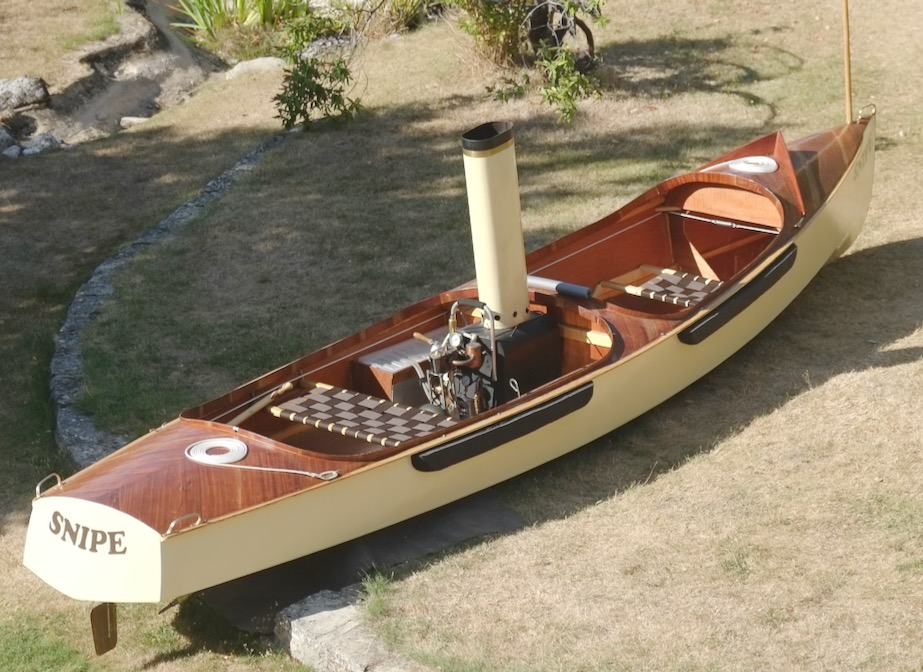
Cover
Camping skiffs are usually 7 to 8 metres in length, and therefore carry the weight and the bedding space to justify the use of hoops and a camping cover. Lightweight canoes might find covers rather an unsafe encumbrance, particularly in side winds.
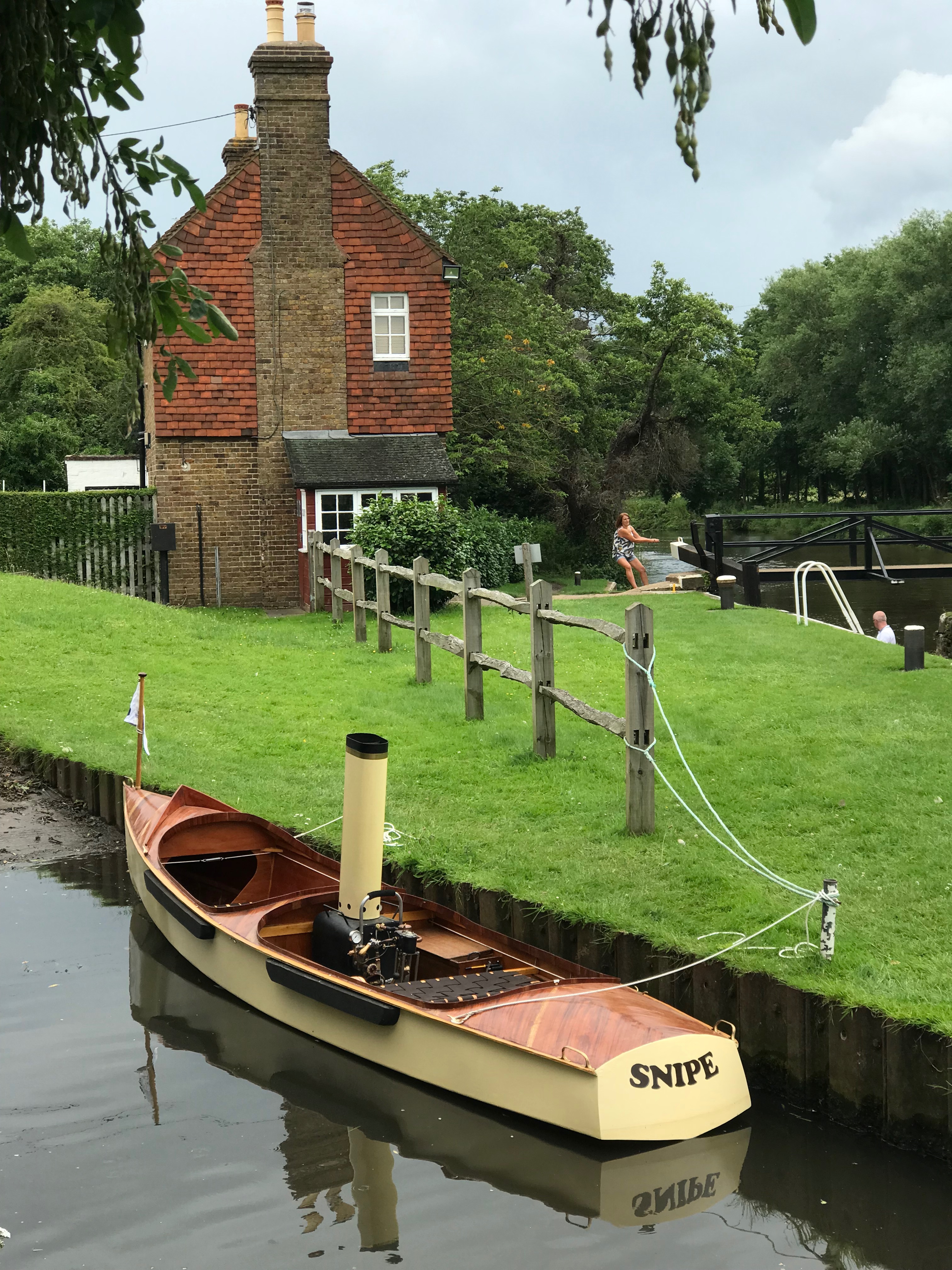 A tie down tonneau cover which can be used if trailing or moored, is however a very useful thing to make. It requires a removable funnel, and should only be used with a safely dead fire of course.
Statutory Requirements on UK waters
Your chosen water will almost certainly require a licence to operate a powerboat. In turn that will require third party insurance (£3million for SBA Rallies), and a boat safety certificate, That in turn will require a boiler test certificate.
The good news about the boiler certificate is that under SBA Appendix 3 rules for monotubes, the certificate lasts for 5 years with interim inspections of protective devices at 26 months.
In contrast, Boat Safety certificates for any open solid fuel steam launch are ridiculous.The only statutory items involved are fire extinguishers, and the most sensible extinguisher is a bailer full of water, and a bailer isn’t on the statutory list.
Boat naming and identification requirements vary according to the waterway, but I would suggest that 3 inch name letters are a start. Some authorities are combined, for instance under the Canal and River Trust, although many canals are not under that licence. As an example, a trip from Shepperton west of London to Byfleet (about 6 miles), involves a non-tidal Thames licence, then a National Trust licence for the Wey Navigation, and finally a Basingstoke Canal licence. The two canals use different sized lock keys too.
……………………………………….