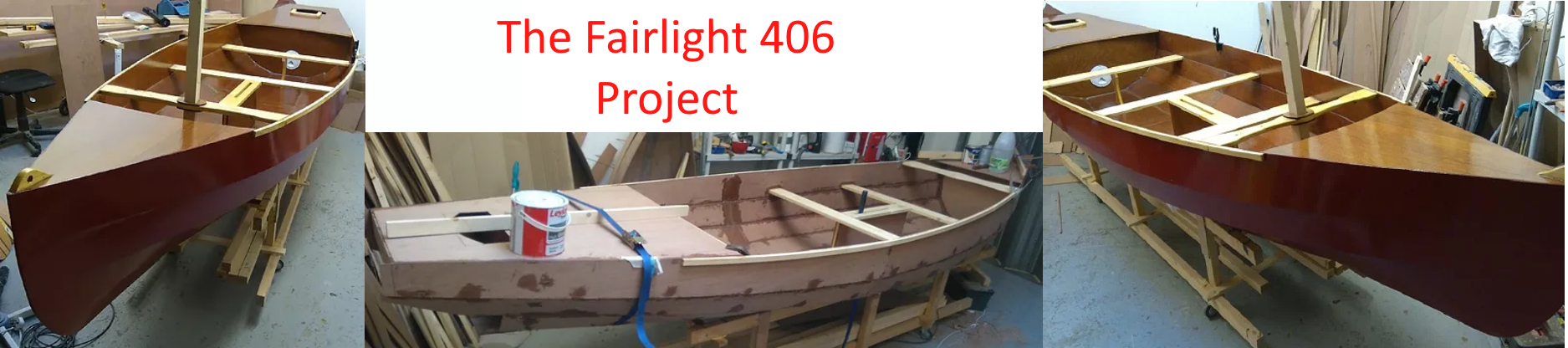
The photos above and the text below are taken from the vendor’s website: Stanley Small Craft
"The Fairlight 406 is a very versatile boat that can be paddled, rowed, motored and sailed. It was designed from a canoe but given a transom and a stern overhang after much discussion about what it should be. However, eventually, as no decision was made, it became the multi-purpose boat it is now.
LOA: 4.06m (13’ - 4”)
Beam: 1.05m (3’ - 6”)
Dry Weight: 45kg (89lbs) approx.
Height Forward: .575m (1’ - 10.7”)
Height Aft: .480m (1’ - 7”)
Height Amidships: .415m (1’ - 4.3”)
Crew: 3/4 adults
This great little boat was designed for a family holiday where two wanted to be able to paddle, one wanted to row, my wife wanted to use our electric motor and my daughter and I wanted to sail. We had to find a way of making it do all four! In addition to this it had to be transported on the roof rack of our Kia Rio so, dry weight had to be kept to under 50kg. At just under that, the Fairlight 406 was the result.
Basic Materials Required:
3 Sheets of 4mm Plywood
1 Sheet of 6mm Plywood
6 kg/ltr Epoxy Pack plus Fillet (glue) Additive
Fibreglass Tape"
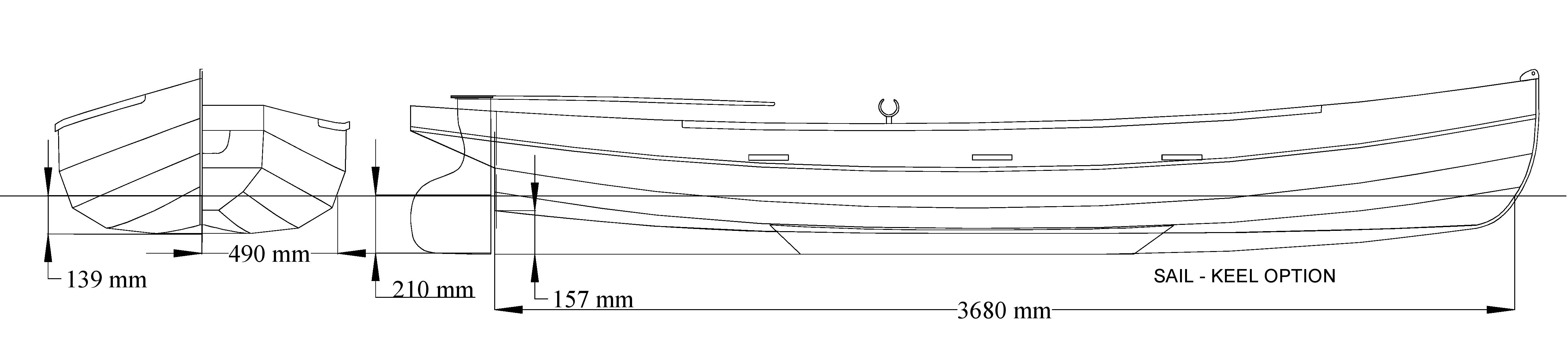
As a customer, the first step after acquiring the drawings was to measure them and gather some important dimensions and then get to work in a spreadsheet to work out some extra data items.
Of particular interest were the displacement to provide an idea of the carrying capacity of the canoe, the block co-efficient which confirmed that it has a very slippery and easily driven shape, its notional hull speed and finally the amount of power required to push it at that speed. These are all widely available formulae so the job did not take too long.
LOA = 4070mm, 13.35 ft.
Breadth = 980mm, 3.22 ft.
Depth = 139mm, 0.456 ft, 5.47 inches
Waterline Length = 3680mm, 12.07 ft.
Displacement = 0.2587 cuM, 258.71 kg, 0.254624 Long Tons
Block Coefficient = 0.00000052
V = 1.341 X (WL in ft)^0.5 = 4.66 knots, 5.36 MPH.
Rule of thumb power required = 1.75 horsepower per ton (2240 pounds) of displacement = 0.45 HP
Thinking About a Propeller
As a rule of thumb, launch propellers should have a diameter equal to 10% of the boat’s waterline length, and have a pitch equal to, or slightly larger than the diameter.
10% of waterline length is 368 mm or 14.49 inches
Actual space for keel added sailing version is 209 mm or 8.23 inches (56.8% of ideal).
Thus some thinking and calculations are necessary to come up with a workable solution. The output I have generated using Dave Gerr's book, The Propeller Handbook, is as follows. Some items do not seem to be quite right to me. Part of the problem is that for such a small light boat the calcs are all off the bottom of his charts.
Power requirement (SHP) = 0.47 HP
SL = 0.088
Estimated Slip = 0.583% This seems a very unusual figure and will be discussed further below.
Suggested propeller size - this varies significantly with engine revs:
Summary Table
Shaft Speed---Diameter “ ------ Pitch “ Pitch Ratio
300 ---------------- 13 -------------- 19 ------- 1.46
350 ---------------- 12 -------------- 16 ------- 1.33
400 ---------------- 11 -------------- 14 ------- 1.27
450 ---------------- 10 -------------- 13 ------- 1.30
500 ---------------- 09 -------------- 11 ------- 1.22
550 ---------------- 09 -------------- 10 ------- 1.11
600 ---------------- 08 -------------- 09 ------- 1.13
The original hull design in the sailing mode (i.e. with a keel and skeg) suggests only space for a 6 inch propeller if the propeller is not to drop below the line of the keel. Given that this is the sort of boat for exploring little creeks and shallow waterways it would be a shame to increase its draft with a lot of bronze hung under the stern. Thus I was idly wondering about twin screws. The idea has been well tried by the Victorians in the launches that they built for work in the 'Colonies'. Whether it would be possible today I am uncertain. There are certainly plenty of very small plastic propellers offered on eBay, though I have seen none that are left handed.
Addendum: I have done a few more calcs. I have assumed that the slip figure for a single screw is the same as for a twin although strictly twin should do slightly better. I have also assumed that the shaft horsepower from the single screw calc is split into two for the twin calc since there would only be one engine. The figures that emerge rather suggest that it is hardly worth the bother:
Shaft Speed---Diameter “ ------ Pitch “ Pitch Ratio
300 ---------------- 11 -------------- 19 ------- 1.73
350 ---------------- 10 -------------- 16 ------- 1.60
400 ---------------- 09 -------------- 14 ------- 1.56
450 ---------------- 09 -------------- 13 ------- 1.44
500 ---------------- 09 -------------- 11 ------- 1.38
550 ---------------- 08 -------------- 10 ------- 1.25
At this stage it perhaps makes sense to assume the use of one of the many available propellers to take the design of the transmission forward. Looking Online it would appear that the small propeller market is dominated by replacements for outboard motor propellers with 7.5" (190mm) being very common and a limited range of pitch measurements. However some of these propellers have reasonably small hubs so there might be some benefit to searching further.
Using the online calculator available from Good Calculators, one can work though some possible combinations of propeller dimension and slip.
Using the ubiquitous 7 1/2" propeller and a pitch of 8" (203mm) with the shaft turning at 600 RPM and an assumed slip of 58% then a speed of 2 MPH would be achieved. That is somewhat below the estimated figure for V of 5.36 and not would be very reasonable performance on the water. The SBA's Steamboating Guide has a 'rule of thumb' figure for slip of 0.35 or 35%. Putting that into the formulae with a 7.5" propeller and 8" pitch suggests a speed of 2.95 MPH. Cranking the pitch up to 10 gives a speed of 3.7 MPH which is better. This suggests that a propeller with a larger pitch would be useful but given the lack of space one may have to go with what is available.
Whilst on the topic of small propellers the Internet searching turned up the product shown below. It is the propeller for the long shaft motors used widely in the far east for which a conventional shape may not be appropriate. 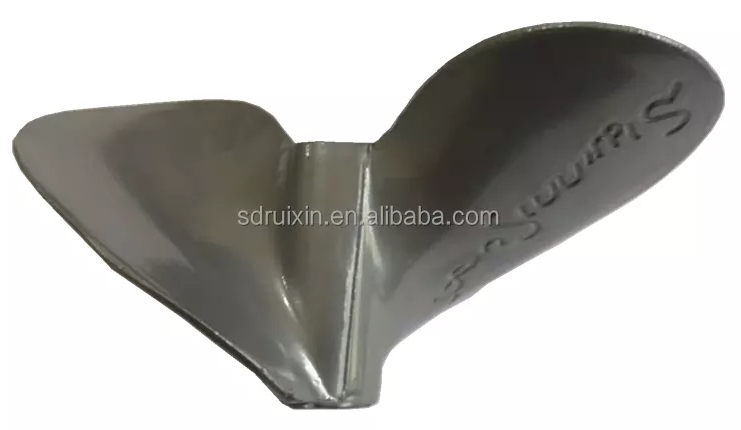
Looking westwards a site called Mud Skipper sells a range of propellers for long tail drives. The most promising of which is the Super High Speed Prop No 6. This is aluminium and has a pitch of 9" but looks as if careful attention with a hammer could advance that to a bigger figure.
While on the topic of propellors, I recall that in a discussion on another forum, I was referred to the website of a person who was offering a design of a propellor especially designed for human powered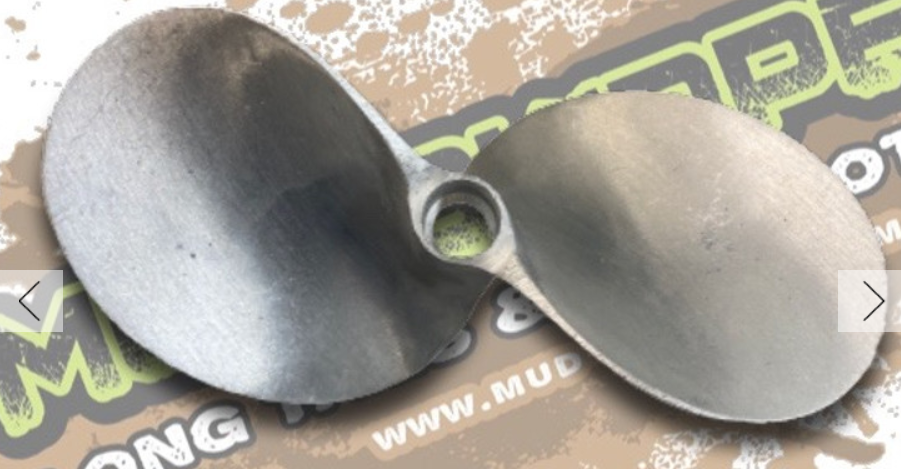 boats. Sadly, I seem to have lost the URL of that so if any reader knows of it I would appreciate the chance to have another look since last time I was in a hurry.
Next on the agenda will be a secton on the modifications to the Fairlight hull to accommodate the steam plant and to fit the prop shaft and rudder.
Next: The Propeller