John Draper's Triple Coil Boiler
John Draper is the owner of SL ‘Flaming Galah’ and sent a short article to Steam Leak, the magazine of the the Steam Boat Association of Australia. He has kindly expanded it to share with world-wide readers who may not yet have heard of SL ‘Flaming Galah’.
Here are a couple of photos from my phone. I had an interesting day winding the 316 stainless superheater coil for the 'new' mono boiler for my 'new' boat, 'Whisky Tango'. The outer coil is a full 60ft of 3/8" copper tube acting as a water wall and sits above a refractory bowl in the Jetwave casing that I was mucking around with some years ago. Rolling the copper coil was easy. I laid the tubing out flat down the passageway, clipped one end to a metal drum and rolled away. Easy!
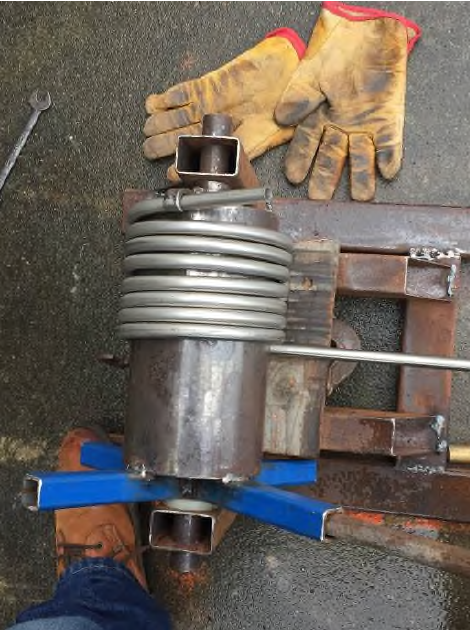
Equally surprising was that the tube coiled nicely, and the windlass didn't break! Stainless is tough stuff and try as I might to keep tension on the roller, the 'spring-back' gave a slightly larger diameter coil than expected. Next step is to roll an intermediate coil from 3/8" (10mm) stainless tube to link the outer and inner coils, then connect the separator/manifold, install the burner, and try it out!
Hopefully the attached plans make sense of this.(See below)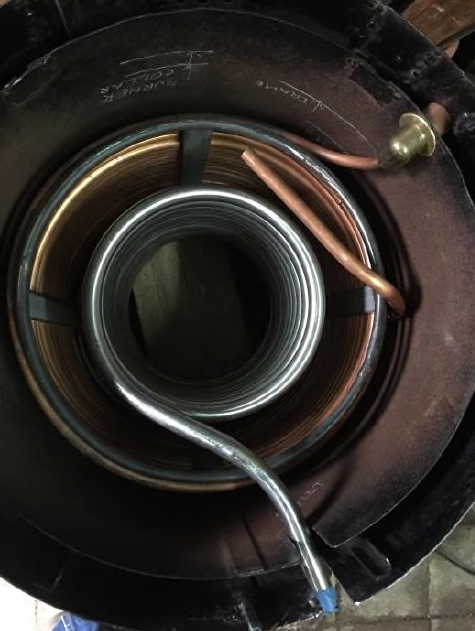
The above is the most recent of several attempts to re-purpose a defunct pressure-cleaner into a reliable steam generator to power a boat. I bought the Jetwave as scrap some 15 years ago, initially just for the water pump, diesel burner and fittings to use in my steam sharpie, 'Flaming Galah', and these devices eventually ending up in 'Galah's' power plant.
This used a rather large multi-coil unit of 5/8" black iron pipe, which was tricky to manage due to its excessive volume. The feed pump had trouble keeping up, with the resulting charges of either hot water or highly superheated steam making engine control quite a challenge. Eventually the coils rusted through due to brackish feedwater, and the unit was scrapped.
I then turned to the Jetwave unit (whose coils had also been scrapped), and, inspired by an article by Jim White in 'The Funnel' (Funnel - Issue 109 Summer 2001 Jim White – I’ve got to start somewhere) expounding the virtues of his 'bi-tube' system I decided to give it a go. Unfortunately I deviated from Jim's plan by using 3/16" OD stainless tubing which, although it raised steam quickly, required a huge amount of heat from the diesel burner, and a lot of pumping effort due to back-pressure, straining the engine.
E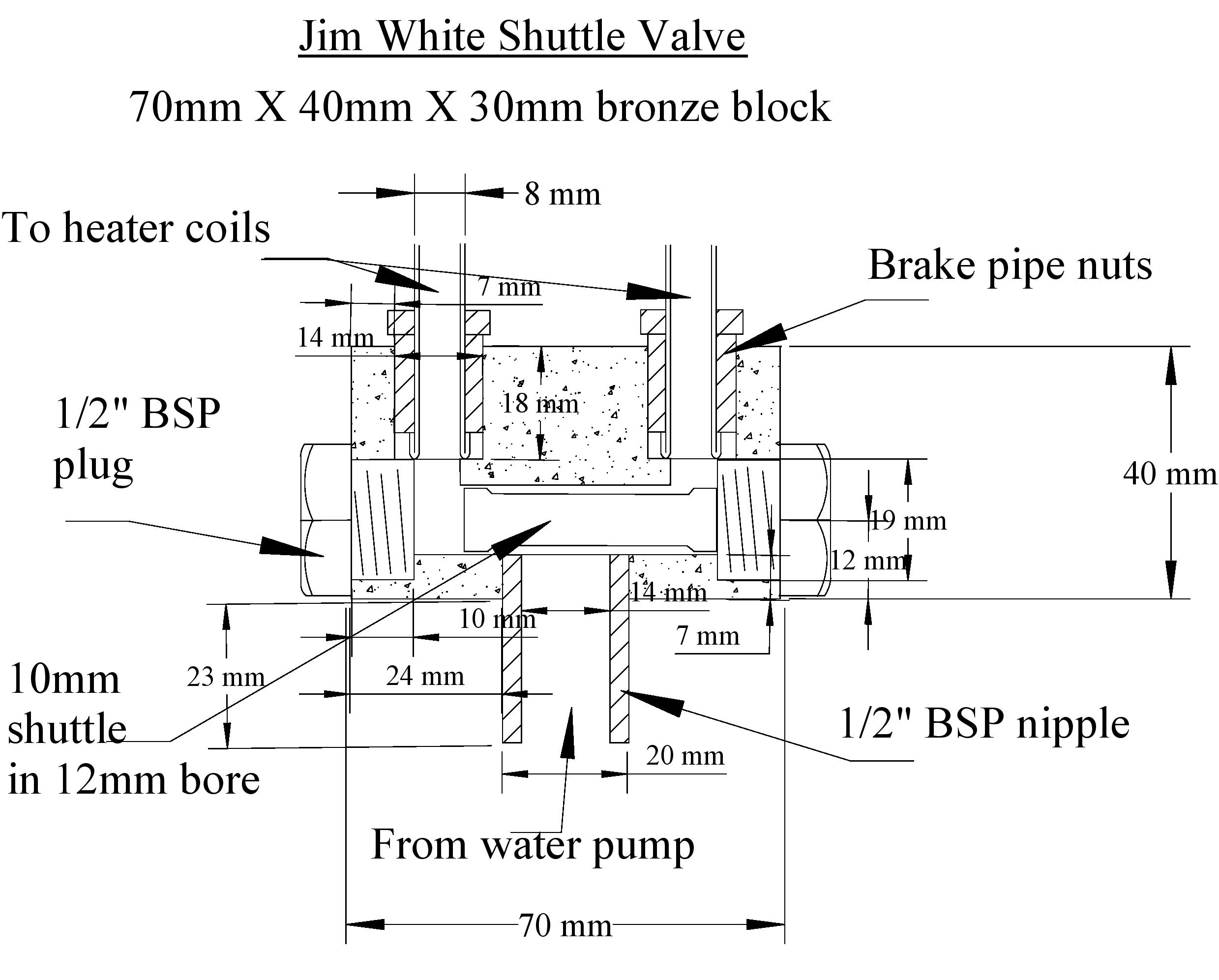 ventually I made a new unit from scratch, using a cyclone firebox with the 'gun' oil burner, and new pancake-style coils of 3/8" copper tubing which worked very well, generating 120 -150 psi at cruising speed. The 3-ram pump provided plenty of feed without overloading the engine. The steam temperature was controlled by a needle bypass valve and a thermal cut-out on the fuel pump solenoid to prevent extreme overheating. This set-up has had several incarnations as the bottom coils were susceptible to thinning from the scrubbing action of the flame. The latest version of this plant is powering Flaming Galah to this day.
Which brings me back to the Jetwave, and my 'new' boat, 'Whisky Tango', which is a larger cabin version of the Galah and borrows many of the proven features of the earlier boat. In this case, the copper coil (60' of 3/8" copper) forms an outer 'water-wall', connected to a double helical coil of 3/8" to 1/2" stainless tubing (20 ft each) with the burner firing downward through the central (superheat) coil into a refractory basin, the heat travelling upward between the intermediate (generating) coil and the copper (economiser) coil. I am yet to TIG weld the joints and fittings in the stainless section. There will no doubt be a period of testing and 'improvements' before in-water trials, so it could be a while before I can announce the results.
The above photographs and give some idea of current progress. If all goes well, hopefully, we will be in the water in months. We shall see...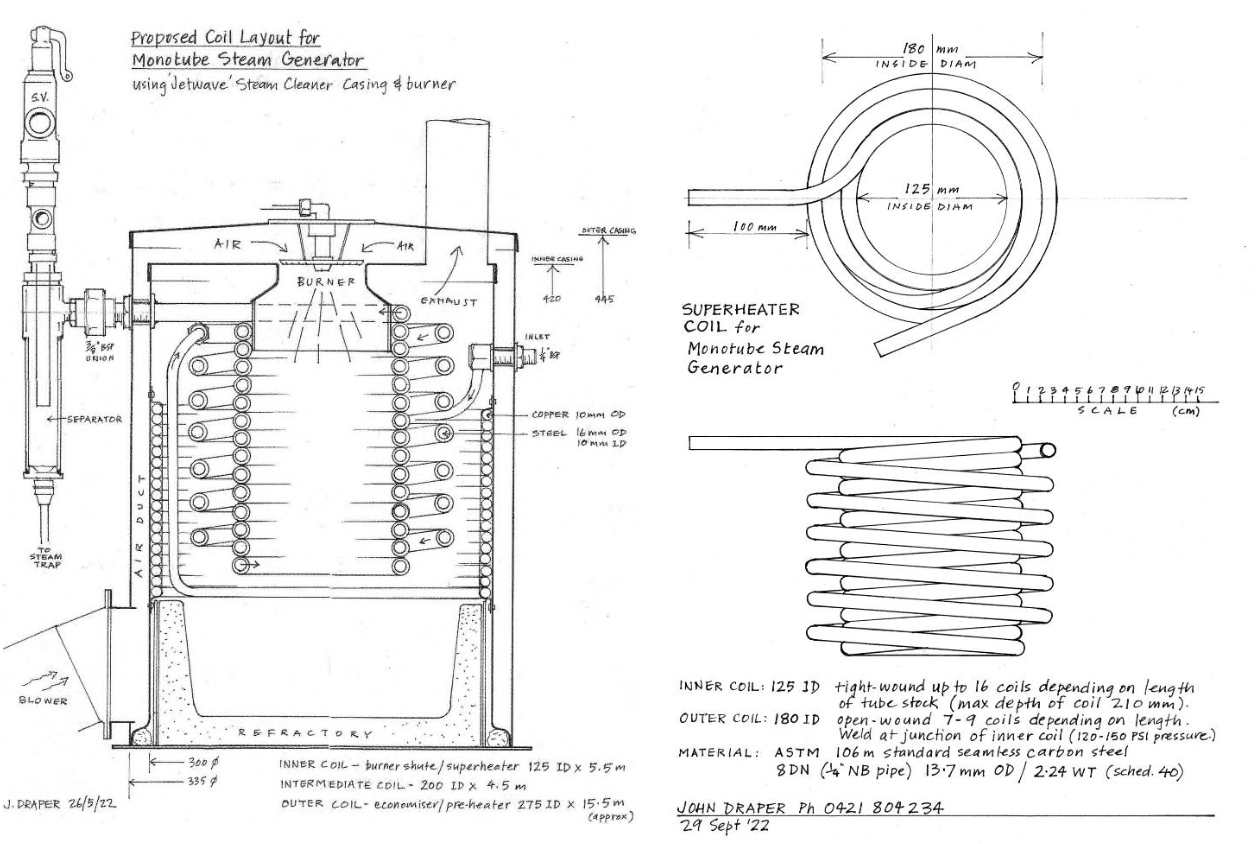
The plans published above were basically drawn to show to an engineering firm how to roll the coils for me, using 1/4" NB seamless steel pipe. Fearing an exorbitant cost, I thought I'd have a go myself, using 6m /20' lengths of stainless steel tubing from local suppliers (rolled on-site with my home-made coil winder!) The S/S coils have turned out well (so far, so good), which means that I can roll my own if replacements are necessary!
My 'Jim White' design had a shuttle valve very similar to the drawing above although the shuttle itself was hollow (with a soldered end cap) to save weight. I think the critical issue in that context is the fit in the shuttle body. It must be not too loose and not too tight... Another one of those 'iffy' specifications that seem to affect mono-tubes! The valve certainly worked. It would click back and forth merrily depending on load, but would occasionally jam from impurities in the system. These were usually a piece of grit or teflon tape. I never got to try out without the shuttle... I wonder if it is really necessary?
And of course, my tubing was too small - 3/16" OD, 1/8" ID - and the combustion space way too large, so the heat would simply rush through the coils and up the funnel. Of course, I just cranked up the burner until the funnel caught fire! I was going up the 'tethered hydroplane' path there. This would've worked IF: (1) the flame was slowed down and concentrated around the coils, (2) the pump was scaled down and sped up (Jim got that right, but I was making do with the 3-ram existing pump and loading up the engine), and (3) I had not lost patience and sorted these things out! That said, I still have the bits, so might have another go one of these days.
The next design attempt was a much smaller version of Wally Mounster's stainless mono-tube but using copper tube - an outer 5/16" dia x 20ft economiser with a double helix up-and-down slightly conical central coil of 3/8" dia copper, feeding into a simple separator. This worked beautifully but as I mentioned before was subject to flame erosion, as well as stress cracking as the coils expanded and contracted in the heat. Those diesel gun burners put out a lot of heat, but can be tuned like a carburettor, by adjusting jet size, fuel pressure, and air flow... something I have only begun to get right in recent years.
These earlier experimental builds taught me a lot through trial and error, mainly error which led me back to the 'Jetwave' unit which is the basis for my 'new' boiler. This is light, portable, and can be disassembled easily, but I still have a bit to do before it's up and running. I'll keep you posted!
Turning now to the important topic of Controls, my first efforts with Flaming Galah were all over the place as I had no idea what was going on. Like I said earlier, all hot water or red-hot steam! Exhausting up the stack made things worse, with slugs of water mixing with smuts from the burner making a heck of a mess! It was a matter of lighting up the gas burner, cracking the throttle, and hoping for the best.
Over time, with the advent of a few basic controls, things became more manageable. Firstly, I swapped the gas burner for the diesel burner. Diesel was pretty cheap then, and easier to handle than gas, and a lot safer if things did go wrong. It also enabled me to get insurance on the boat! The burner was either on or off, but intensity was controlled by adjusting flame length, fuel pressure, and air mixture, so steam-raising was controlled by metering the feed water rate via a needle valve. Once the engine was warmed up and running, I throttled back, set the needle valve (by watching steam pressure and temperature), and could then sit back. The boat will go all day like that unless one of the controls is altered, usually when I adjust the bypass to raise temp for more speed!
Steam temperature is most important, as it determines the rate of steam production and steam quality. I use a barbecue thermometer to measure steam temp at the throttle. I have found that 350F is ideal, while over 400F and things get interesting, with the engine galloping and squeaking for oil! In case things get out of control, a thermostat on the steam line is set to cut out the fuel solenoid on the burner pump at around 500F. I stole this idea from Barry Watson. A controller from an electric frying pan is just the right temperature range for steam! Another handy device is a thermodynamic steam trap. These are commonly used in industry to clear water from steam lines and which periodically empty condensate from the separator.
And that's about it. All this however makes my boat an 'electric steamboat' - sort of a reverse hybrid, as the burner blower (ex 240V) runs with a 12V auto fan motor, and the solenoid as well. A standard car battery is good for a few days' running (with a spare as ballast) but a solar panel and deep-cycle battery are next on the list.
No doubt there will be a further episode if the Webmaster leans on me.
John Draper
January 2023
January 2024 - The Wemaster has leaned and this is the response:
G'day there Peter. Great to hear from you, oddly enough on the day that I had my first on-water trial in SL 'Whisky Tango'. We have been waiting for ages for a day that hasn't had torrential rain or howling winds or scorching sun, but today the Gods smiled upon us. But not for long.... the steam trial was disappointing to say the least!
I'd steamed up in the driveway a couple of times in recent months and all seemed well - the diesel burner worked beautifully and steam was raised in seconds. The engine (2.5" x 2.5" V-twin) was not quite as lively as expected, but after warming up started to romp along nicely. Of course, the prop was just spinning around in mid-air, but it seemed that there was plenty of oomph to push the boat along at a decent pace. Today's test proved otherwise!
We launched the boat (jamming the cable in the winch in the process!) then tied up alongside the ramp to fire up. Steam was up quickly as expected, but couldn't get past 40psi, so I hopped on the hand pump to hurry things along. Of course, all this did was to prime and flood the engine. Turns out the safety valve spring had lost tension and most of my steam was going skyward - it pays to look up occasionally! So, out of the water (after sorting out the winch) and head home, rather than attempt repairs in the car park surrounded by curious onlookers and the inevitable questions, like "Why dontcha get an outboard?" Why, indeed.
I'm now pondering the next steps, having fitted a new spring to the SV. But before I rush back to the water (50 km away) for another trial I'm having a bit of a re-think about things - like, is the V-twin too big, or just badly made? It has a few leaks and seems to eat steam! Also, it is geared up to the prop shaft 1: 1.3, driving a Hypro twin-piston pump as well. The Hypro delivers a lot of water, maybe too much? Then there's the issue of other leaks in the system, from valves and fittings, which also affect efficiency. Funny, I went through all this 20 years ago with my first boat, 'Flaming Galah' - I thought I'd got it right with this one but apparently not! So here we are. Whisky Tango will go back under covers for a while (looks like a wet Xmas for us too) and boating will be on the back burner for a while. But for our next outing I'll run the twin on one cylinder only, direct drive to the prop, and see how it goes. That was the solution to Flaming Galah's dragging of heels, burdened as she was with step-up drives and wide-open throttle running, amongst other things. Also, I have a 3" x 2.5" single on the bench nearing completion, which I will be testing as well. That said, I have no doubt that the new monotube is a fast and efficient steam-raiser, but now I need to cut the clutter and look at those issues that may prevent it from reaching its full potential. Looks like I'm still a few months away from that, so meanwhile....
For those who like to know how things work in the mono-tube world here is a diagram of the steam plant in Whiskey Tango:
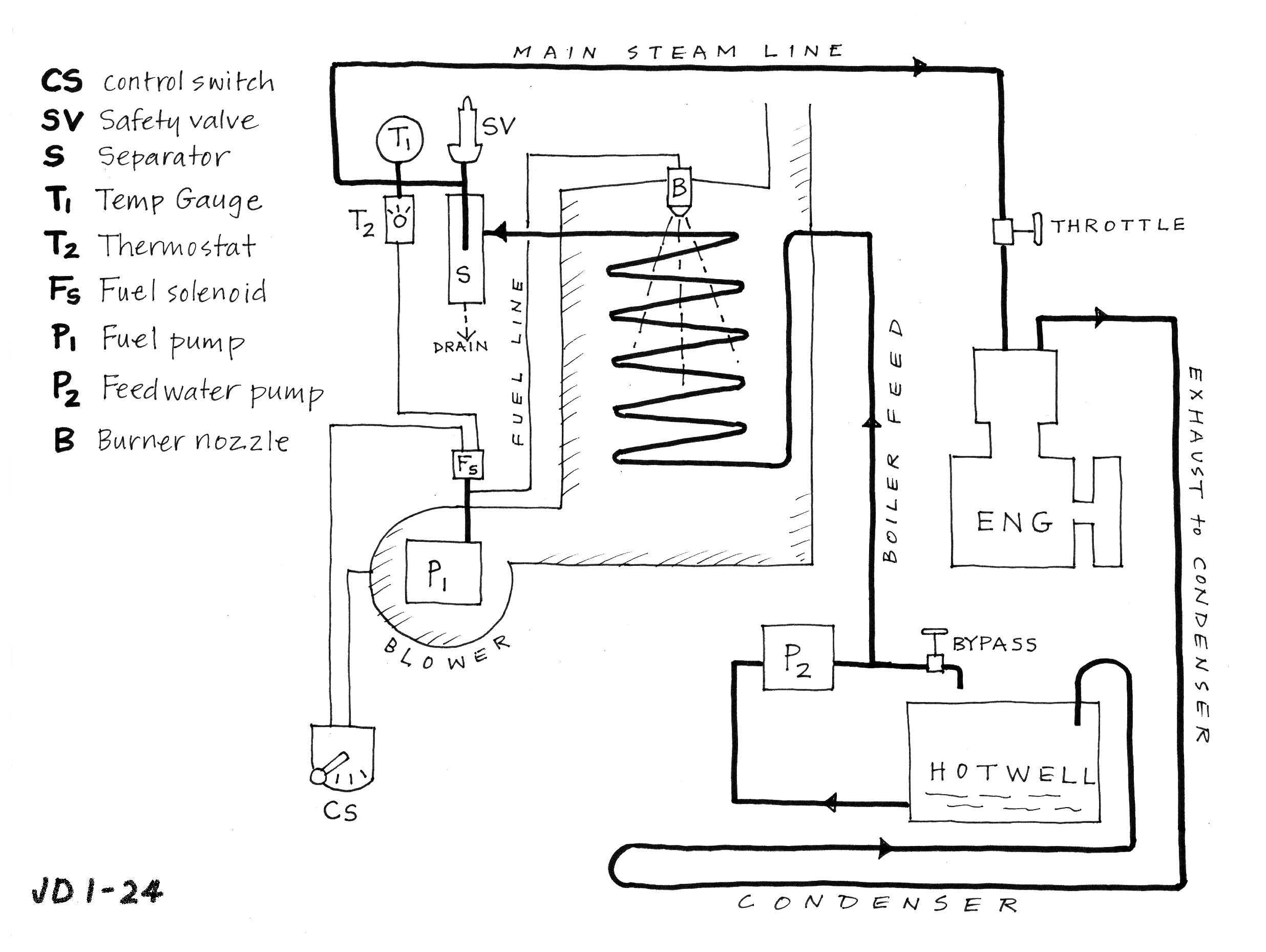
The control switch activates the blower fan, fuel solenoid, and ignition circuit (not shown). The pumps are mechanically driven - P1 (fuel) by the blower motor shaft, P2 (boiler feed) by the engine, with manual by-pass to hotwell. I like the idea of complete auto control, but my experiments with Flaming Galah have shown that once the feedwater rate has settled down, it is virtually in 'auto mode' anyway, with the odd tweak of the bypass to raise superheat for a tad more speed if the weather comes up. The boat is therefore driven by the bypass setting rather than the throttle, which is usually just cracked open, allowing pressure to remain constant. If I fiddle too much, everything goes out the window, with either too much wet steam (priming) or highly superheated steam (but not for long, as the burner solenoid will soon cut out over 500F). That said, I like the idea of 'race mode' using electric feedwater pumps and a second burner nozzle/fuel pump... maybe one day...
I'll send some pics as things progress.
Cheers, John