13th June 2026 - Thinking about the Pump(s)
13th June 2026 - Thinking about the Pump(s)
The next apparently logical step in the control programme is to consider the feed pumps. Given that the feed pump is probably the most critical component of a mono-tube plant, two identical electric pumps were purchased from AliExpress. These are replacement items for cordless pressure washers and were quite inexpensive. There was no user manual but the motor body has the following stamped upon it: GRS 550VC5S21V,GT MOTOR CCW. 032023 08:25. The exact site from which it was bought would take some time to find, but on Ali Express several vendors were offering what was apparently the same pump. The site specification was: "Herctools 21v pump for pressure washer Pump body and gearbox: zinc alloy Plunger: stainless steel Pump cover: plastic (not supplied) Gear: stainless steel". The advert label is "21V Pressure Washer Zinc Alloy Pump Head Plunger Portable Lithium Power Cleaner Accessories Car Washing Machine Pump Host". A photograph is shown below. Interestingly, the motor, the pump assembly and the gears are all sold separately as service parts.
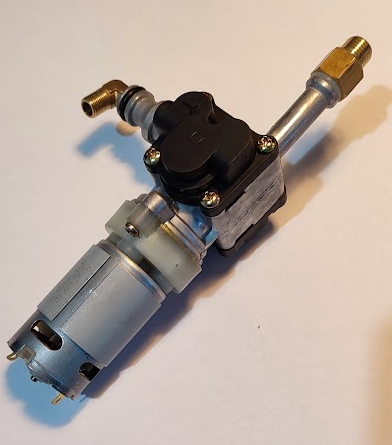 |
The outlet from the pump is threaded M15 while the inlet is set up for a clip on hose. That issue was by-passed by drilling out the inlet and tapping it to 1/8"BSP and inserting a screwed elbow. Screwed elbow has the same diameter as the 1/4" BSP hose tail connection and thus the silicon pipe from the hot well is an easy fit that can be secured with a Jubilee clip. The M15 outlet will happily accept a 15mm to 1/4" BSP adapter.
A key question at this stage is whether the expenditure on the two pumps was a waste of money or will they do the job of feeding the coil with adequate water? The preceding question is how much water will the coil need? That can be calculated from the operational characteristics of the engine. The Fairlight proposal is going to use a Stuart Turner Cygnet engine and at the very start of this thread there is a table that sumarises the characteristics of several similar mono-tube steam plants. For this question, Taniwha is the relevant vessel as it also uses the Cygnet engine.
Shortly after that early post was published a reader fortunately checked the calculated water demand for one of the boats and pointed out that the table's figures were "way off". A warning note was added to the table and now that water demand is the current topic, the entries have been correctly re-calculated and re-posted.
The Cygnet running on 90psi at 400 rpm will theoretically consume 0.32kg/min of water turned into steam. However, the stated operational condition of these steam plants is they will run with 'over pumped' conditions and that the steam will be 'wet'. That means that the minimum calculated figure is too low and needs to include some extra, perhaps 18-20%. That would give a requirement of 0.38kg/min to turn into steam and condensate.
The good news is that the pump's flow rate is 2.8 – 3 Litres/min (L/min) which is more than enough to meet the demand. The other question is whether the pump is powerful enough to pump against the mono-tube's design pressure. That is 90psi (0.62 Mpa) while the pump is specified to operate up to 1.2-1.3Mpa which should be more than adequate.
The next issue to consider in the planning is that the pump is rated at 21v and the control system based upon the Raspberry Pi runs on 5V. Deep Seek suggested that the following power consumption figures were likely:
| Power Rail | Voltage | Current (approx) | Power |
|---|---|---|---|
| Pi + sensors + displays | 5V | ~1-2A | 5-10W |
| Pump (running) | 21V | ~6-9A | 125-190W |
| Pump (stalled/starting) | 21V | ~15-20A (brief) | 315-420W peak |
It is possible to use a single battery to drive these components but to be useful it will need to be able to support them for at least two hours. That is the typical running time of a morning or afternoon session of a steam boat rally. That also implies that there will be two such batteries as lunch breaks on rallies seldom guarantee the availability of power to re-charge a single battery. However, this would only be possible with a 21V battery bank using a step-down DC-DC converter (21V → 5V, rated for 2-3A). This is efficient and common in mobile systems and relatively inexpensive but adds to complexity. There is also the question of battery failure while in use. Should the battery fail in use when it is supplying both the pump and the control system then the whole plant fails. If the two are powered separately then there is the possibility of keeping the plant going with the hand pump. However, the hand pump delivers 39cc per stroke when working correctly and the estimated water use for this plant is 380cc per minute (0.38 L/min = 380 cc/min). That works out at 10 strokes per minute continuously if the plant is to be kept running. A fit user might keep that up for 5-8 minutes, but not for any time longer. That emphasises the need for there to be two batteries which are quickly switchable from reserve to main.
Thus it begins to look as if the general design of the pump and control box is for there to be two batteries of equal capacity that are quickly switchable on-line or off line. The control system would probably be best with a single battery that would last all day, although a socket into which a phone backup battery could be plugged would probably be useful. The two batteries will need to 'live' in a waterproof box as getting Lithium batteries wet is not a good idea. The battery for the control system can probably 'live' in the project box that will house all the other electronics.
With those decisions made it is probably the right time to move onto the hardware specifics for the batteries and their controls.