26th September 2025 - No More Water!
26th September 2025 - No More Water!
The pump has been dismantled and, since the ordered O rings have arrived, it has been re-shod. The barrel has been seriously washed out to make sure that no more swarf was lurking in its depths and the leaky non-return valve was also washed out. With that done the pump was re-assembled yet again and the various pipes re-connected. The manifold was disconnected from the main coil and then mounted in the vice. Domestic and family issues intervened for a while but eventually attention was re-directed to the manifold. The plug in the safety valve was then removed with considerable difficulty and the excess Stag jointing paste cleaned off. It is horrible stuff, but does seem to make joints leak proof.
With that done the safety valve was searched out and dusted down. It was given the Stag and PTFE tape treatment and then it was screwed into the port. For once, serendipity was acting favourably and the final turn to tight left the outlet port on the safety valve pointing exactly where it needs to be for the vent pipe. However, the vent pipe is a few jobs further on and so a short length of scrap pipe was attached to carry away any water from the test.
The final hydro test was intended to check whether the safety valve would open at the marked pressure and how it would perform if that pressure remained. Since the pump was connected up again, it was simply a case of topping up the hot well and starting to pump. The manifold water separator vent was left open inititally and, as before, the first few pump strokes delivered black water, but once it cleared the valve was closed and pressure began to build. The overhauled pump pushed up the pressure quickly and the red line was soon reached.
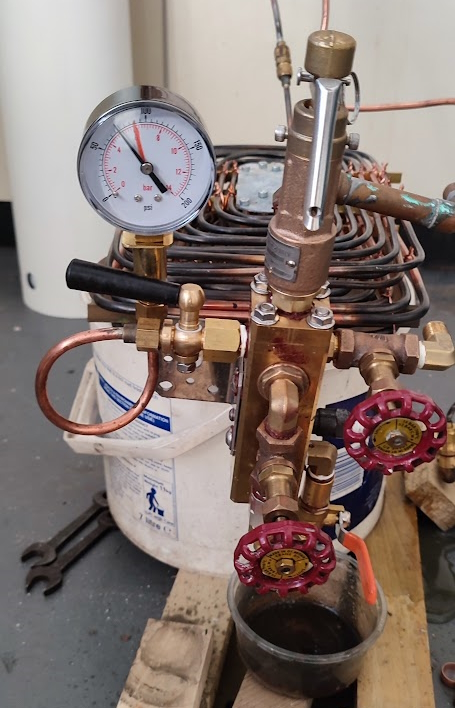 |
The pressure went a little over the line and then the safety valve went 'pop' and spat out a slug of water and the gauge dropped back below the red line. It was hard to keep up that pressure with the pump, but it was clear that the sfety valve would pop and re-seat until the pressure was again strong enough to lift the valve. There was certainly no chance to pump and to wield a camera.
Having stopped pumping and grabbed the camera the picture shown was quickly taken. It was anticipated that the pressure shown on the gauge would quickly drop away. However, nothing happened and the gauge sat at just over 70psi. The implication taken from this was that should the safety valve blow, then system pressure would probably drop by about 20 psi before begininng to re-build. It will be interesteing to see if that conclusion is supported by the evidence when the system is hot and running on steam.
The time in the garage was cut short by a call from the house and the whole set up was abandoned. Coming back an hour later it was surprising to see that the gauge was still reading 40psi. Clearly, the non return valve and the pump were not showing any significant leaks and the various joints were not weeping either. That was a very satisfying discovery.
With that test completed it is probably fair to say that the Hydro Testing stage is, for the most part finished. The coil will need to be put back into the casing, the joints re-made and the thermocouples attached. With all that done it will be necessary to do a 'final' hydro test to ensure that all the re-made joints are tight.
Next on the agenda is to start work on the control system. First on the jobs list for that is to set up the Raspberry Pi micro computer and acquire the scrip necessary to get data from the thermocouple. Once that is to hand attention should probably turn to the script necessary for managing the electric pumps. They are nearly ready for use, but their inlet ports need drilling out and tapping 1/8" BSP for the hose connectors. That is a job that has been 'ducked' because the drilling and tapping will have to be done from underneath to keep swarf out of the pump's mechanism.