Getting the casing for the boiler assembled should be, it would seem, a pretty simple task. The proposed boiler is simply a copy of the existing Snipe boiler so the job should only involve measurement and the drawing of the design for the material suppliers.
As so often can be the case, the task has turned out to be rather less simple than it would at first appear. The casing had been drawn earlier in discussion with John Emmett and the drawings were thought to be a good approximation of the actual casing. However, some thought was put into the issue of them going to material suppliers who would use them to laser cut the sheeting and then bend as directed in the drawings. It was realised that the suppliers would need a reasonable understanding of the whole casing to help them understand the individual pieces.
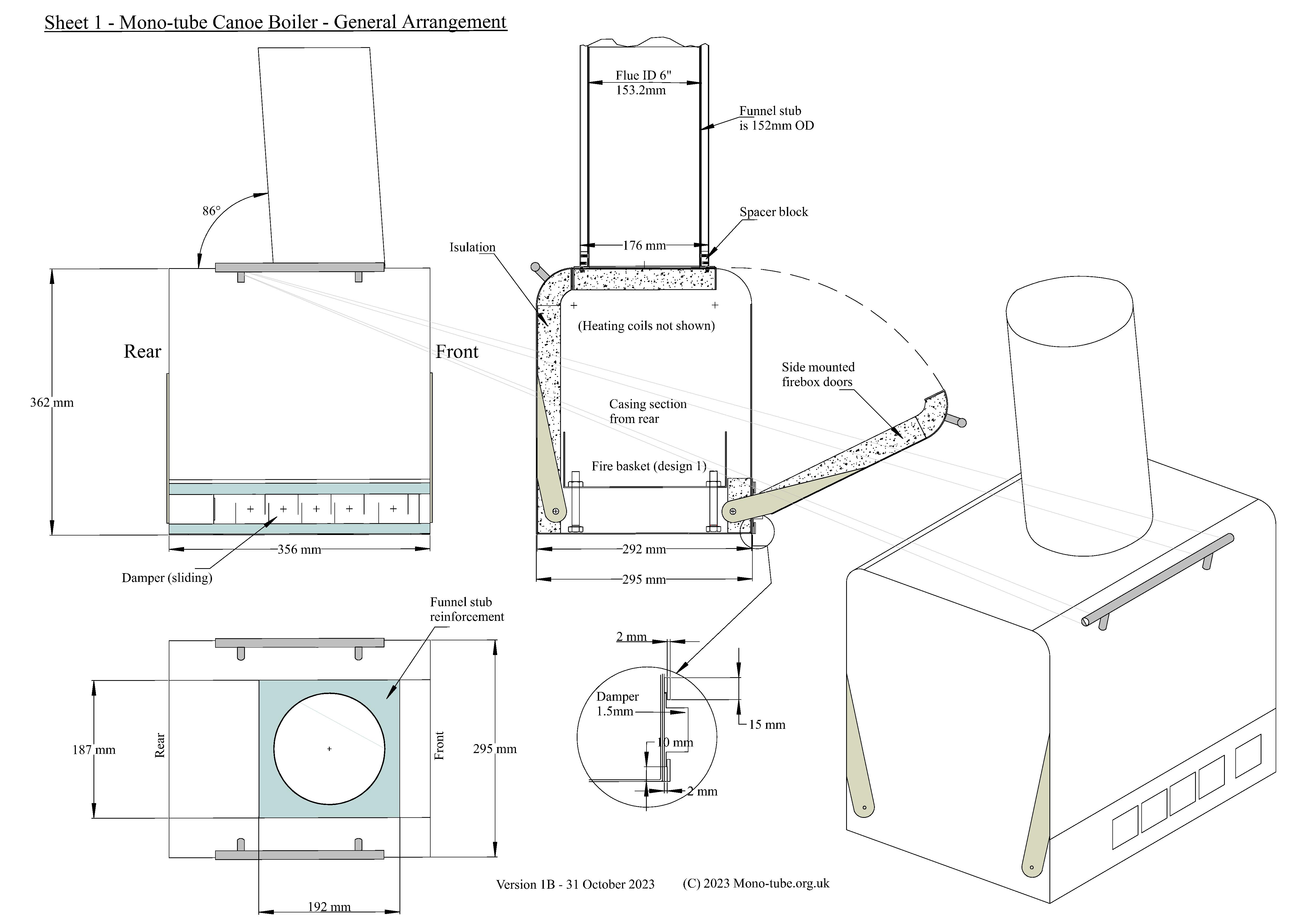
Thus a general arrangement drawing was put together first. Naturally that would have the plan and elevation of the assembled casing, but should it have sections? Should there be an isometric view? How much detail in the way of dimensions should be included? It was also realised that it would be important to ensure that each drawing sheet had a specific number and an edition number so that any feedback from metal suppliers could be pinpointed to the correct sheet. That was also necessary in the correspondence with John who was tasked with checking and commenting upon each drawing and subsequent versions.
The General Arrangement drawing ended up as follows:
(To download a copy of this drawing please click here.)
In the process of developing this drawing the discussion led to some alterations of the design. For example the damper air vents had originally been circular, but by changing them to square it was possible to increase the potential air input by 27% (from 1,257sq mm per hole to 1,600 sq mm per hole.) This should allow in more combustion air moving at a slower speed. Similarly, it was discovered that the original Snipe boiler had a 5” flue. By re-designing the top plate it was possible to increase that to 6”, an improvement of 126.7sq cm to 182.4 sq cm (44%). There was also discussion of the strength of the funnel stub since this supports the much taller double skin funnel. Previous experience with a different vessel has suggested that this component must be very robust and well secured to the top panel. The funnel has been designed with a traditional six degree rearward slope. It was also decided that aesthetically it would look best if the top of the funnel aligned with the longitudinal centre of the boiler casing. That meant that the funnel stub position needed to be quite a long way forward on the boiler top panel.
There was some concern about the weight of the funnel and its possible impact on the centre of gravity of the canoe. For this reason it was proposed that the inner funnel should be made of 0.5mm stainless steel while the outer would be made of 1mm aluminium. John Emmett also pointed out that the original Snipe arrangement had a much shorter inner funnel, again saving weight so that idea was also adopted in the design. Research into the dimensions and availability of ready made flues turned up a specialist flue maker who provided some useful data. They pointed out that it was important to know that in the UK adverts for flue pipe are quoting the internal diameter of the pipe even though adverts do not state that.
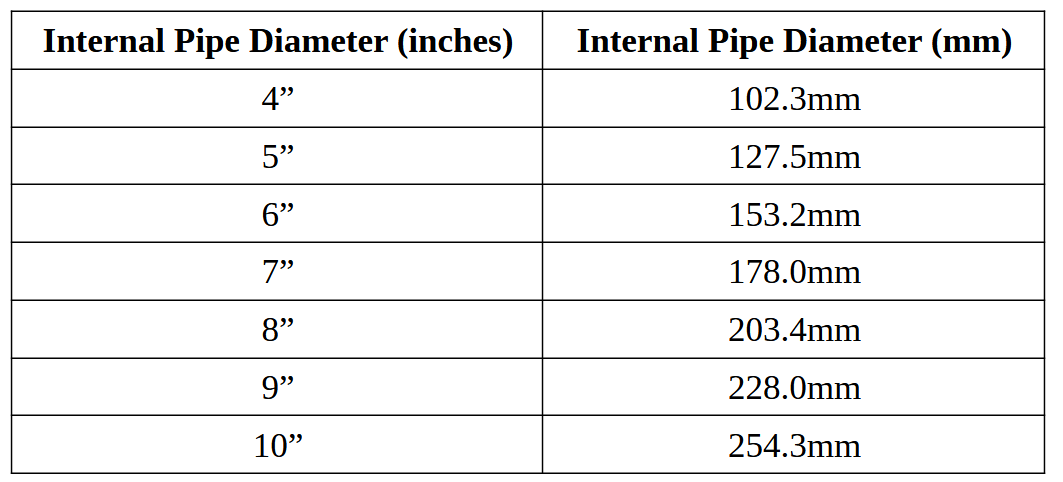
From their website it looked as if they would be able to construct the funnel stub and the chimneys since they produced flues from scratch. In the process of researching flue pipes several other UK based manufacturers were identified; FSM Group, SFLtd, Schiedel and there may be others.
The final design for the chimneys and the chimney stub is shown below: (To download a copy of this drawing click here.)
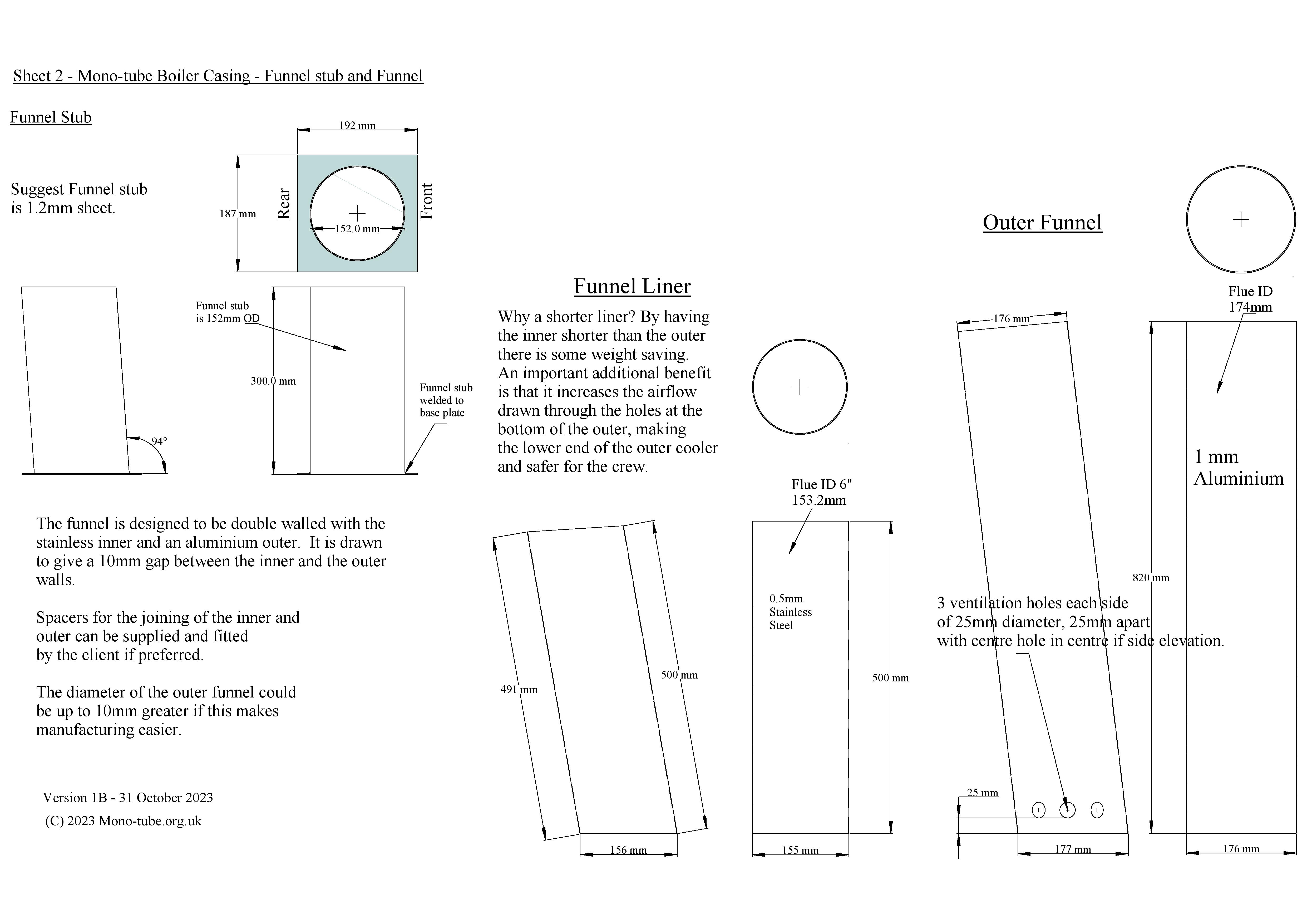
Since the chimney makers are assumed to be experts it was felt unnecessary to draw the chimneys in their flat sheet state. The metal suppliers, by comparison would need more information since their specialism is in accurate cutting and folding of metal in whatever shape the customer specifies. Expertise was assumed for the casing panels in that the shape and finished sizes of the folded panels was supplied but no data on bending allowances was provided. The only exception was the grate panel in the firebox which in its flat state is a simple shape but folded appears rather complex. (To download a copy of this drawing click here.)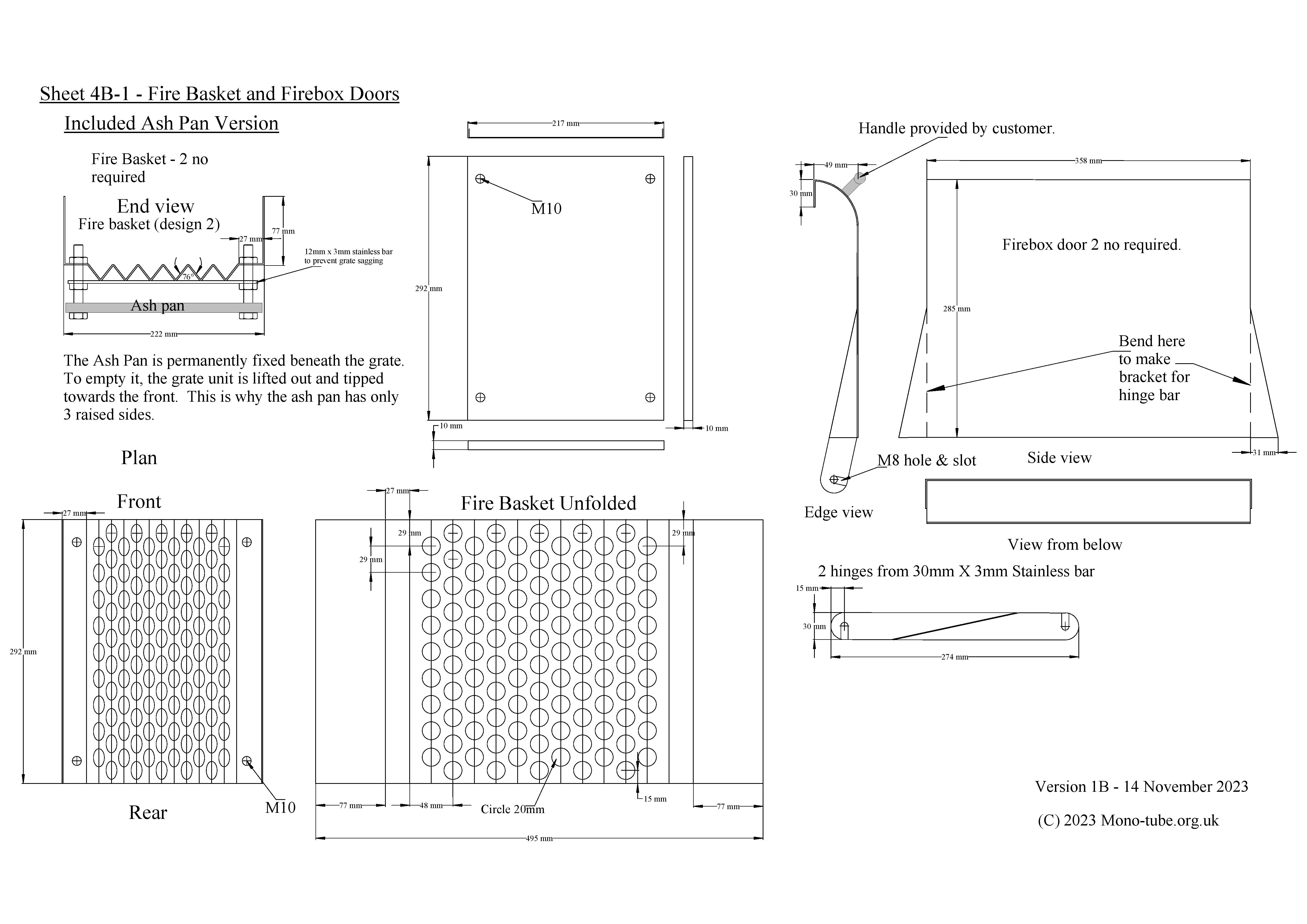
At about this point in the design process the discussion moved to the issue of the material to use for the casing. John Emmett reported that for Snipe 1.2mm Zintec had been used for the base and for the top panel, with 0.9mm Zintec for the other items. This appeared to have worked well over four seasons and was not found to be under specified. However, looking at the metal supplier websites it was interesting to see that aluminium and Zintec were pretty much the same price. Thus it seemed worth raising the question as to whether there would an advantage to using aluminium. The latter had been used for the previous full sized boat and had worked well.
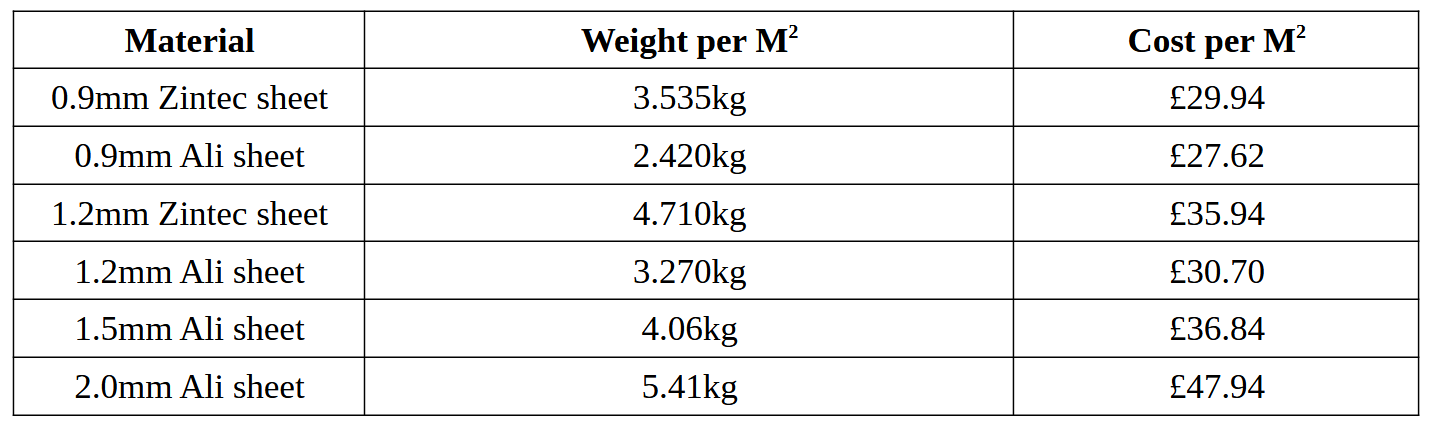
To assess the differences the following table was prepared:
It is not correct to assume that aluminium can be used as a direct substitute for steel without considering three important variables;
• Ultimate tensile strength (UTS): This is the maximum stress that a material can withstand before it breaks.
• Yield strength (YS): This is the stress at which a material will permanently deform.
• Modulus of elasticity (E): This is a measure of how stiff a material is.
To work out the thickness of aluminium (t) equivalent to steel it is possible to use the formula:
t_aluminium = t_steel * (E_steel / E_aluminium) * (YS_aluminium / YS_steel)
However, given that there are different grades of aluminium and different grades of steel it could take some time to get the correct parameters for the equation. It seemed sensible to see if there was an existing ‘rule of thumb’ for a quick, but approximate answer. It seems that such an answer can be obtained by multiplying the steel thickness by 1 2/3. So for 0.9 mm steel the aluminium equivalent would be 1.2mm and for 1.2mm steel the aluminium equivalent would be 2mm.
On the face of it, the table shows that 0.9 aluminium is significantly lighter than Zintec, but one needs to remember that it is not as strong. Using the rule of thumb substitutions the aluminium sheet required is both heavier and much more expensive than the steel. Thus the decision comes down to whether to follow the rule of thumb or whether to stick with the steel dimensions that have already been tried in Snipe.
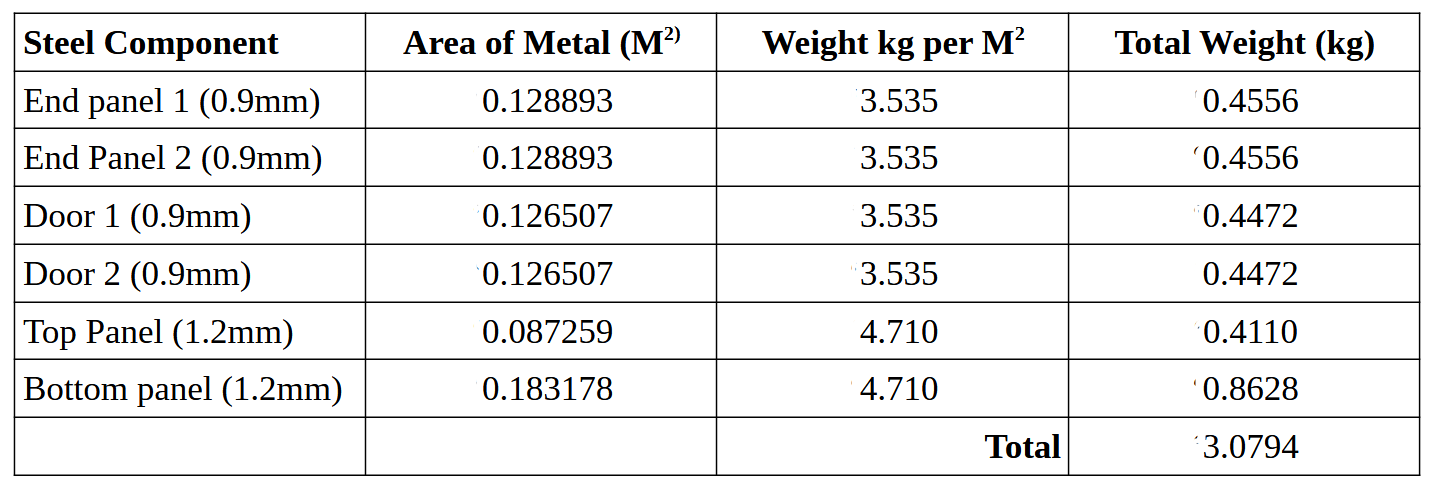
To help with that the casing components have been measured for area is shown in the table below:
By comparison the components in aluminium, adjusted for the extra thickness recommended in the rule of thumb, gives:
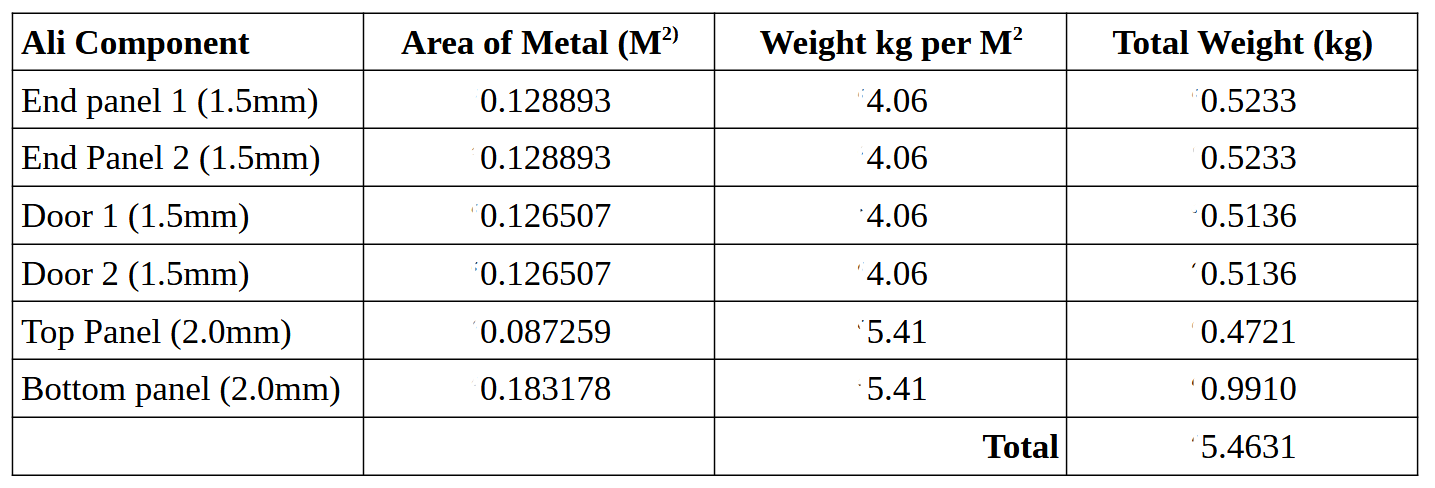
The table clearly shows that using aluminium in a way that maintains the strength of the equivalent steel components makes for a heavier casing. Thus Zintec seems to be the best solution.
A further discussion was raised about whether the casing should be adapted to include an ash pan. As designed there is no easy way to remove ash since the base panel is fully enclosed and basically fills with ash as the fire burns. Adding an ash pan would make post use clean up easier, but the down side is that it would add weight.
It would be possible to allow for a port at the front of the casing into which an ash pan could slide. However, to do so would also require re-positioning the damper air holes upwards so that the ash pan did not block them.
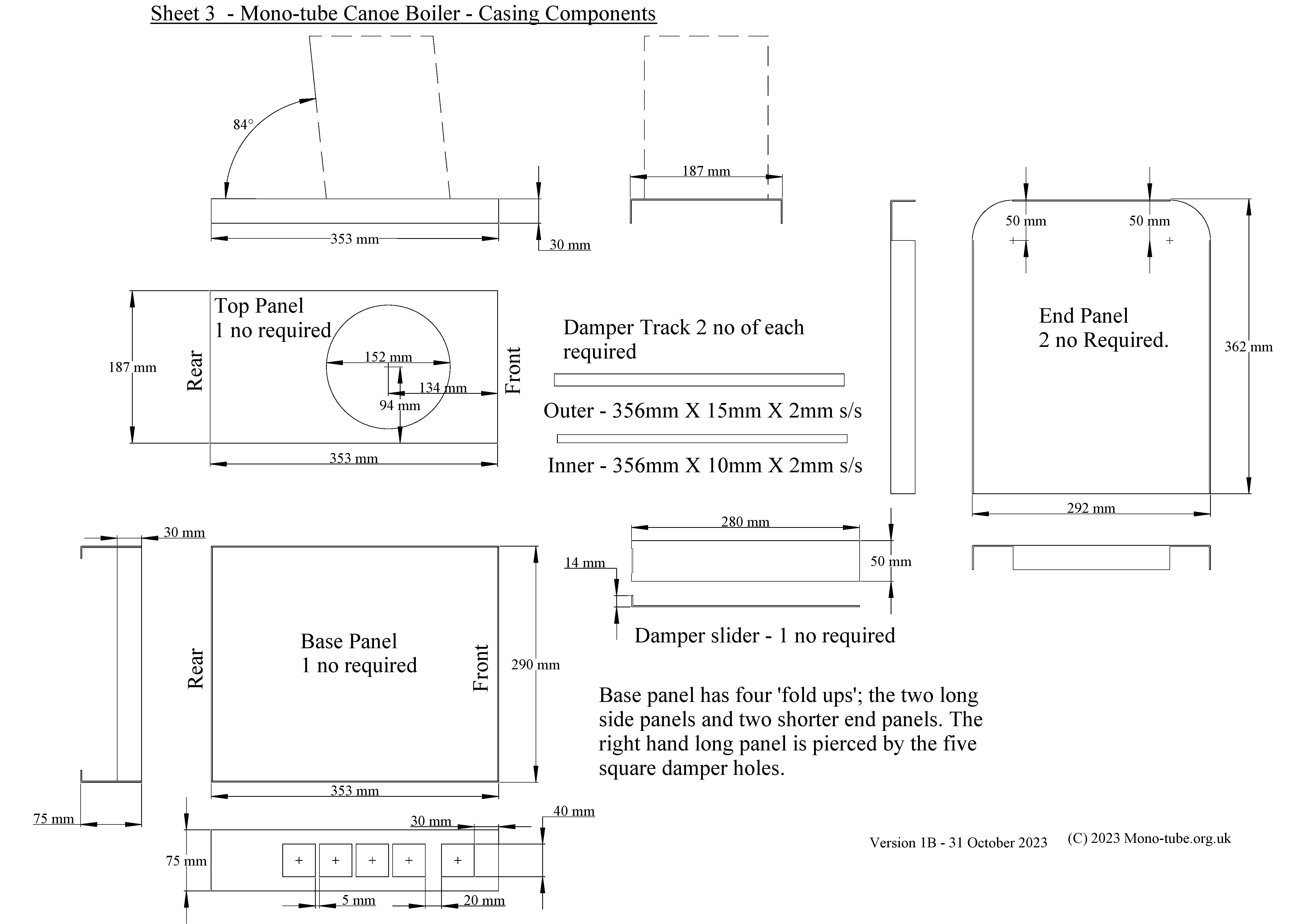
An alternative would be for a tray to be attached to the feet of the grate assembly and then to empty ash one would simply lift out the grate. Such a manoeuvrer ought to be possible as the new design has a much larger combustion space than the Snipe boiler with its horizontal coils. At this point it has been decided that the integral ash pan is probably the least weight solution and is shown in the drawing above.. Drawings showing the other ash pan option are available. Just ask. (To download a copy of this drawing click here.)
With the completion of the drawings for the metal components the next thought turned to the insulation that will fit inside the boiler. This has two principal roles, the first of which is to keep in the heat of the fire so that it does its work of evaporating water. The better the insulation then the less fuel that needs to be burned. The second and equally important role is to protect users and passengers from burns from the casing.
There is a wide range of available materials comprising both boards and matting. The original Snipe boiler was lined with vermiculite board which seems to have been perfectly satisfactory. However, since the whole device is being reconsidered it seems sensible to review the options. In addition, the widening of the top panel to accommodate the larger diameter funnel has led to the sides being moved further apart. To maintain the internal size of the firebox the insulation specification has been raised from 25mm to 30mm.
According to Google Bard the possible insulation materials can be ranked thus:
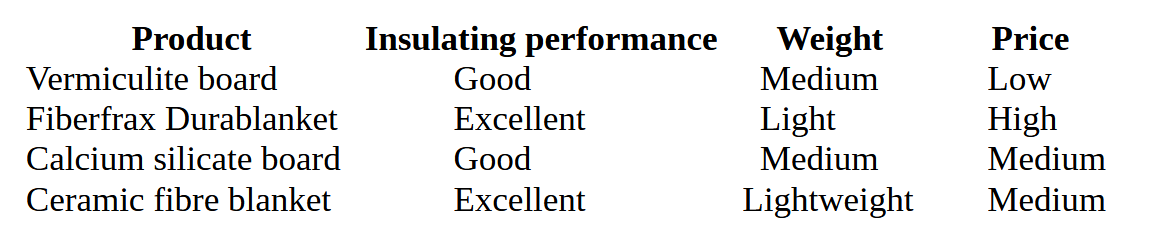
From this table it looks as if Ceramic Fibre Blanket ticks the most boxes as it is flexible enough to follow the curve of the doors, is an excellent insulator, is reasonably light and is moderately priced. Investigation online shows that the material comes in three densities, 64, 96 and 128 kg/M3 with the highest density having the highest performance. The data sheet for Fibrafrax states that at 600 degrees C the Thermal Conductivity (W/mK) is, respectively 0.16, 0.15 and 0.14 which suggests that the product is more than adequate for the task given that a wood stove fire is typically around 300 degrees C.
Sourcing a small quantity of ceramic fibre would appear to be rather difficult as the industrial supplier offer it in very large rolls. Strangely, eBay UK offers 50mm ceramic fibre in the 128kg/M3 version for around £23 GBP (29/10/2023) whereas the same quantity of material in 30mm thickness is £35 with the weight not specified. Further investigation to see if eBay could yield Fiberfrax Durablanket produced nothing. Thus it looks as if the final choice will be Ceramic Fibre Blanket not least based upon availability, but the full specification of the 30mm material will need to be identified before a purchase is made.
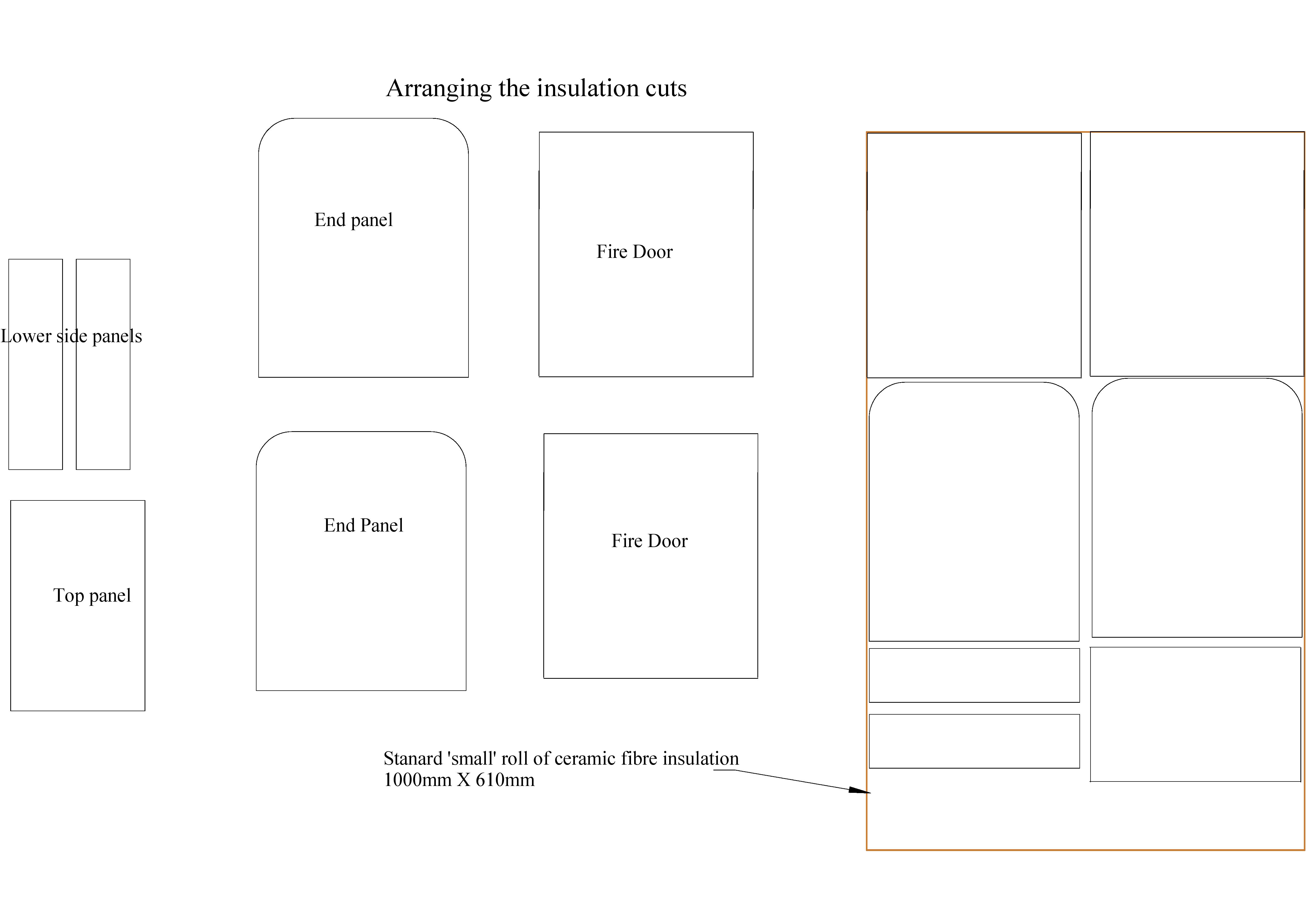
A fairly quick sketch in CAD showed that the standard eBay offering of 1000mm X 610mm was just sufficient for insulating the casing providing the cutting was very accurate. (To download a copy of this drawing click here.)
The next section will go on to report the ordering and receipt of the materials and the subsequent assembly of the casing.
If anybody would like to download a copy of any of the drawings as DXF they are available. Just ask. Don't forget the Copyright in the drawings is held by Mono-tube.org.uk who should be listed as the source if you use these drawings elsewhere.