Building a boiler for a canoe generates a whole host of choices but they are not necessarily easy choices to make. Those with a penchant for history will probably recall that early steam canoes used miniature copies of the 19th Century boilers of the time and burned coal too. Such boilers must have been lightly built to keep down the weight and the users must have been very brave or foolhardy men (they were usually men) to use them. A good example is listed by Bill Durham in Steamboats and Modern Steam Launches (March April 1961 p 6) and is pictured below:
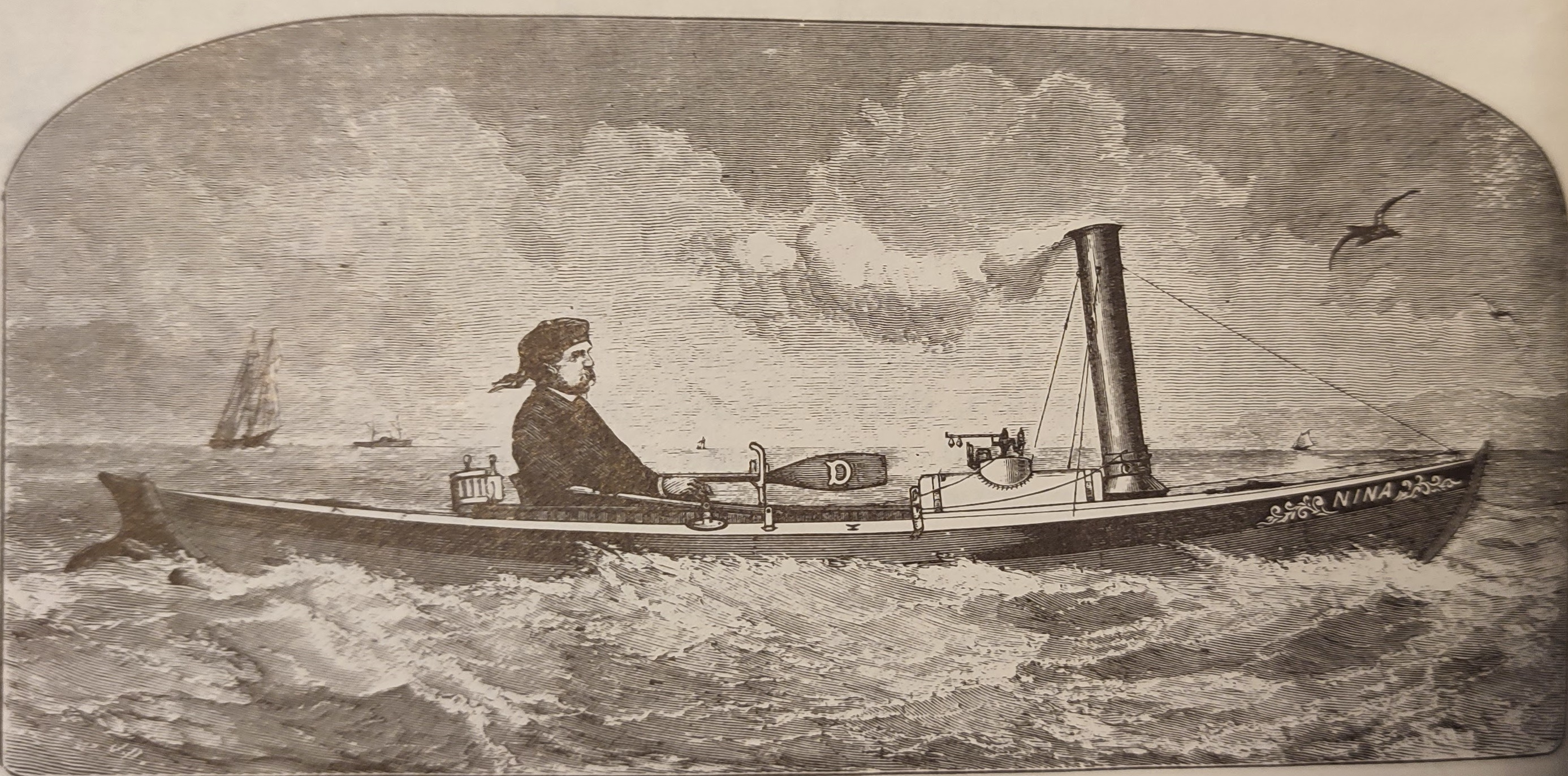
Fuller details of Nina are given in the History section.
By the early 20th century things had improved and the example re-printed in the History Section of this website, dated 1908, shows that the heat was provided by a large Primus stove burning paraffin. Since then the Lune Valley burner, paraffin again, has been adapted and widely used while others have adopted the Pot Burner which allows the use of a much more eclectic range of oil based fuels. The more traditional boiler is still to be found in steam canoes as for example the Dutch canoe Sirius which has a modern water tube boiler design of diminutive size but substantial weight (63 kg).
By the 21st Century canoes with mono-tube boilers by amateur constructors were reasonably common and mostly fuelled by oil or gas. In some larger boats a small number of mono-tube boiler users had adopted wood as their fuel, usually to astonishment of those steeped in "traditional" steam launch boilers. Of these pioneers, Wally Mounster is probably the most well known. In canoes few builders have used wood fuel. A recent pioneer is John Emmett whose mono-tube boiler in Snipe is wood fired using supermarket wood waste logs. Given that high quality steam coal will soon be unavailable and that paraffin is also becoming difficult to find in the UK, the adoption of a re-cycled product available from most supermarkets seems a sensible approach. From a personal viewpoint the use of wood based fuel fits with existing skills honed over many years of living with a wood stove. Youthful experiences with a host of paraffin fuelled appliances have also led to prejudice against this rather smelly fuel.
Thus the first decision of "what fuel?" was not difficult to make. Having made it, the next task was to find out what mono-tube designs were available that would support the Stuart Turner Cygnet that had been acquired for the project. To do that it seemed sensible to work out the steam demand of the various engines that known mono-tube users had in their canoes and small boats. That was somewhat complicated by the need to know at what pressure the boiler was normally used and also what sort of speed was required of the engine in normal use. Some times this information is provided in the SBA Steamboat Register but often it is not. Thus a table was drawn up with the key parameters to allow for some comparisons. *The 'practical' figure is the likely amount that would need to be pumped given that these systems are 'over pumped' and running on wet steam so that more than the theoretical minimum is needed.
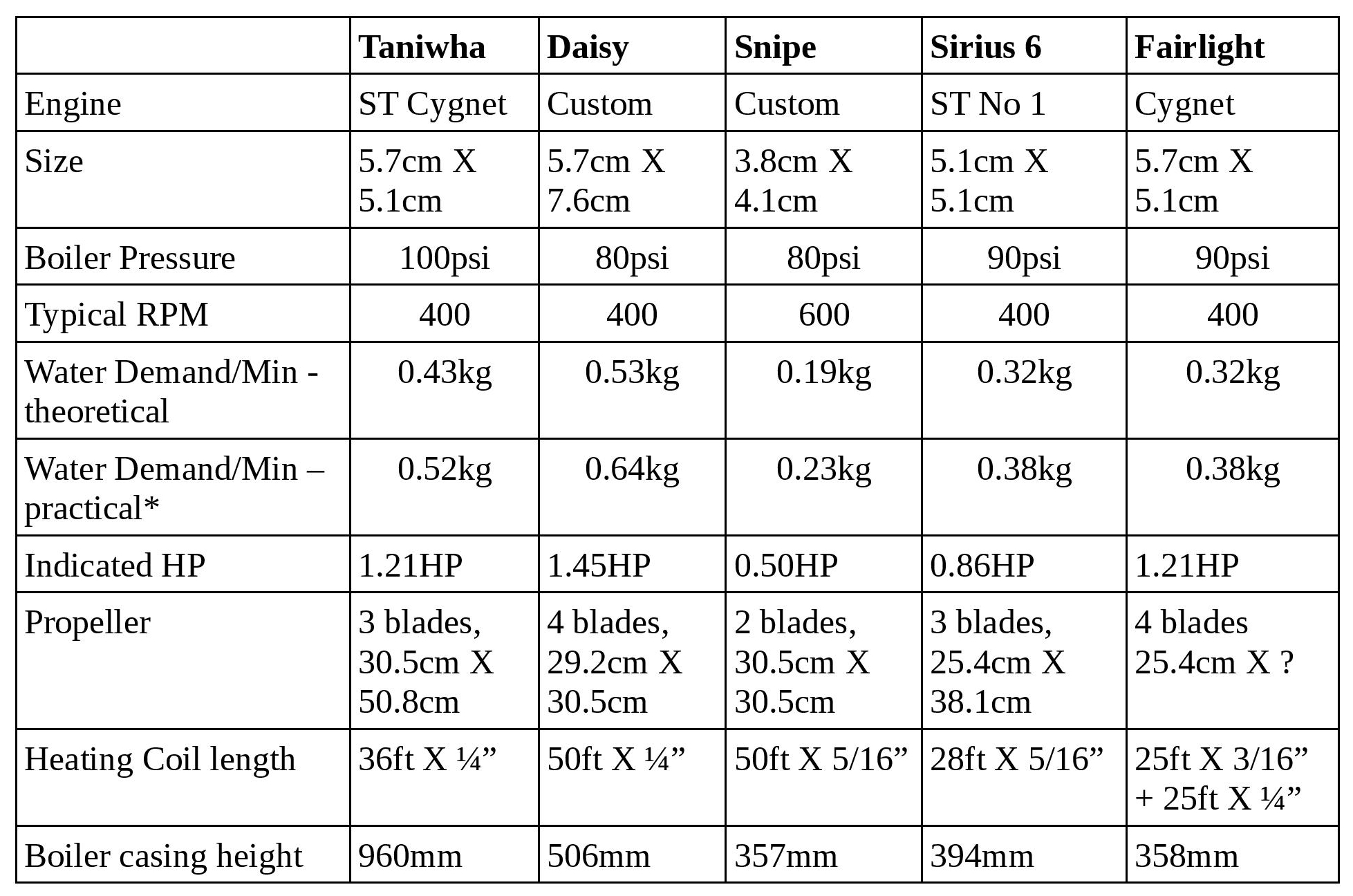 |
The first point to jump out from the table is just how little water needs to be turned into steam to drive the various engines. It is also clear that the mono tube coil does not need to be very long to turn this water into steam. If one chooses 1/4" cunifer pipe then this can be acquired from eBay for £15 (July 2023) for a 25ft length. Two lengths would be sufficient to build all of the boilers listed above which is hardly expensive. [Warning! The "Cunifer" tube on eBay is likely to be steel pipe with a copper plating rather than real cunifer. The real stuff will come with a certificate of authenticity]
The next decision on the list is whether to go for 1/4" cunifer or perhaps 5/16" cunifer since both sizes have been successfully used. However, at this point it is worth referring back to the article by Jim White (Funnel - Issue 92 Spring 1997 p. 36) in which he reports on his troubles with choosing different sized pipe. He references an author going under the pen name of E.T writing in the Model Engineer in 1931. E.T had apparently carried out some tests "on three coils, each made from an eleven foot length, of either 3/16", 1/4", or 5/16" O.D. copper tubing all having the same wall thickness of 0.030", with water supplied by a variable output electric pump, and each coil heated in turn with the same standardized propane blowlamp, the steam escaping through a loaded outlet valve set to blow at 500 psi. In every test the 3/16" boiler gave the biggest output, and the 5/16" the least. The 3/16" coil evaporated 442gm/minute, but in a duplicate coil made of thicker 3/16" tubing, the evaporation increased to 495 gm/minute. The thickness is not specified but any increase must impede heat flow rather than help, even though by only a minute amount, so the consistent improvement found as the bore gets smaller and smaller must, it would seem, be due to the improved surface area to volume ratio. However, the resulting increase in velocity of the water-steam mixture, may well be even more important."
Doing a quick calculation it can be seen that 442gm/min is equivalent to 0.4420 litres per minute and is substantially more than the requirement of any of the engines in the table above. Thus it would seem that 3/16" cunifer should also be under consideration as it is more than sufficient for the task it would be expected to do. It is also very affordable as twin 25ft coils available on eBay for as little as £10.99. (eBay July 2023)
Another issue for consideration when designing a boiler for a canoe is the centre of gravity. The taller the boiler the more unstable the canoe will become. In the table above, the height of the boilers from the boiler mounts to the top of the casing is shown. The figure for Snipe is measured from the boiler but the other figures are calculated from sketches or photographs.
From a boiler height point of view the Snipe horizontal coil design is the best, based simply on height. The choice might be slightly different if the various components had been weighed or had their weights estimated. Nevertheless, it seems intuitively logical that a horizontal coil should take up less space than a vertical one using a similar amount of pipe. However, issue of the funnel and its weight should not be ignored. The funnel needs to carry the exhaust gasses from the fire away from the crew meaning that it should be somewhat higher than the top of their heads. The funnels of both Sirius and Taniwha both look rather longer than necessary for that task whereas the funnel for Snipe is almost too short (See illustration). Pictures of Daisy are quite rare so it is difficult to assess how well Mr White tackled that particular issue.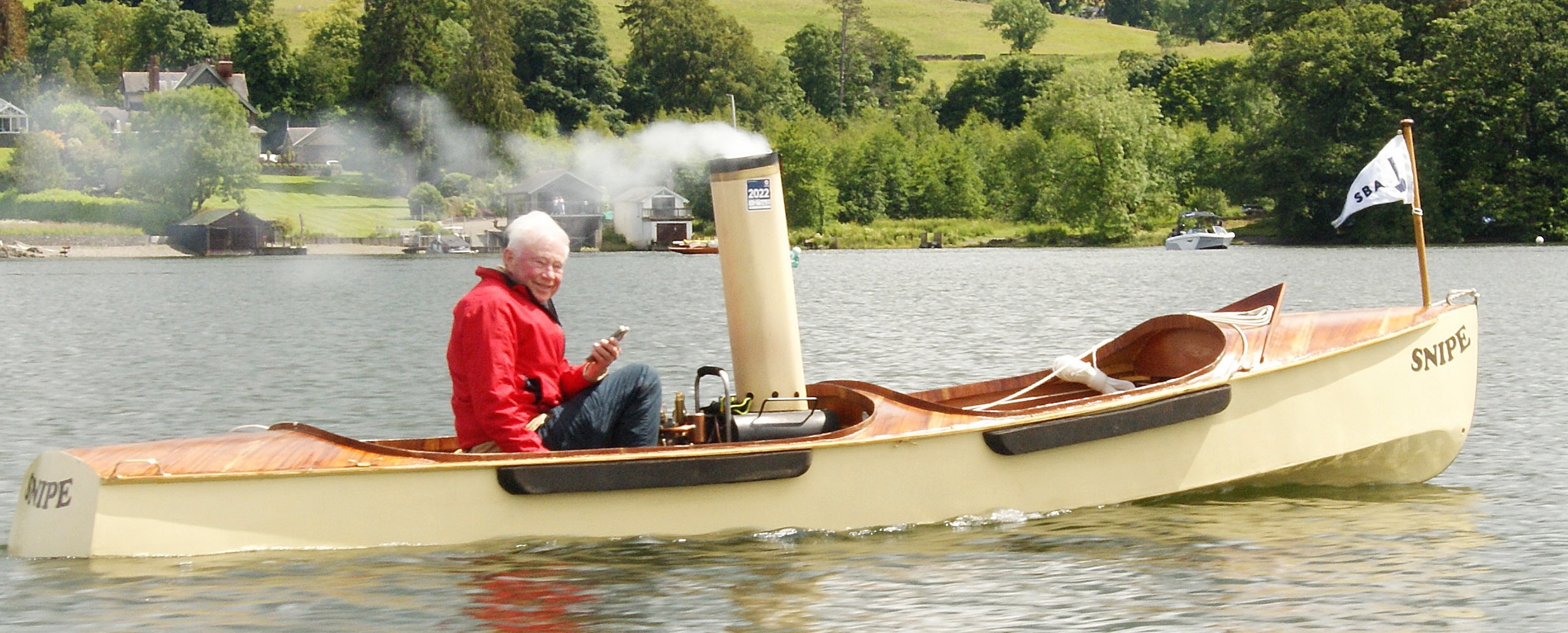
From this discussion it is probably clear that my preference is for a Snipe style boiler since it looks to have a low centre of gravity and could be quite large enough to contain the coil(s) required to provide steam for the Cygnet engine and is designed for wood firing.
In the next section the format of the evaporating coil will be discussed.